| --- |
| license: apache-2.0 |
| tags: |
| - vision |
| - image-classification |
| datasets: |
| - sartajbhuvaji/Brain-Tumor-Classification |
| language: |
| - en |
| pipeline_tag: image-classification |
| --- |
| |
| # MRI-Reader(small-sized model) |
|
|
| MRI-Reader is a fine-tuned version of [swin-base](https://huggingface.co/microsoft/swin-base-patch4-window7-224-in22k). It was introduced in this [paper](https://arxiv.org/abs/2103.14030) by Liu et al. and first released in this [repository](https://github.com/microsoft/Swin-Transformer). |
|
|
|
|
| ## Model description |
|
|
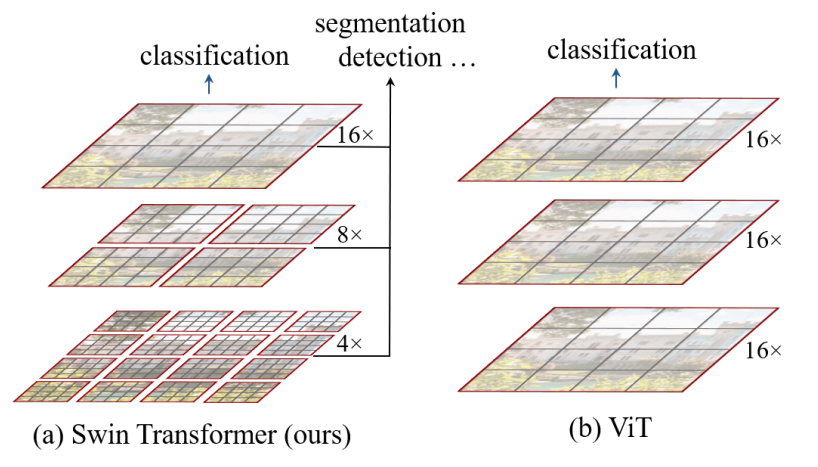
| The Swin Transformer is a type of Vision Transformer. It builds hierarchical feature maps by merging image patches (shown in gray) in deeper layers and has linear computation complexity to input image size due to computation of self-attention only within each local window (shown in red). It can thus serve as a general-purpose backbone for both image classification and dense recognition tasks. In contrast, previous vision Transformers produce feature maps of a single low resolution and have quadratic computation complexity to input image size due to computation of self-attention globally. |
|
|
|  |
|
|
| [Source](https://paperswithcode.com/method/swin-transformer) |
|
|
|
|
| ### How to use |
|
|
| Here is how to use this model to identify meningioma tumor from a MRI scan: |
|
|
| ```python |
| from transformers import AutoImageProcessor, AutoModelForImageClassification |
| from PIL import Image |
| import requests |
| |
| processor = AutoImageProcessor.from_pretrained("NeuronZero/MRI-Reader") |
| model = AutoModelForImageClassification.from_pretrained("NeuronZero/MRI-Reader") |
| |
| # Dataset url: https://www.kaggle.com/datasets/sartajbhuvaji/brain-tumor-classification-mri |
| |
| image_url = "https://storage.googleapis.com/kagglesdsdata/datasets/672377/1183165/Testing/meningioma_tumor/image%28112%29.jpg?X-Goog-Algorithm=GOOG4-RSA-SHA256&X-Goog-Credential=databundle-worker-v2%40kaggle-161607.iam.gserviceaccount.com%2F20240326%2Fauto%2Fstorage%2Fgoog4_request&X-Goog-Date=20240326T125018Z&X-Goog-Expires=345600&X-Goog-SignedHeaders=host&X-Goog-Signature=32461d8d00888de5030d0dac653ecf5301c79a9445320a29c515713611fc8ec5bd6de1f1be490041f0dd937d7165f2bd3176ca926f2f33787a6ca7dbae1db2ce0b3a482a27a6258d4fe64c92ef7004c81488bfede784e50f22742e214cc303e8e9a52c6b4bc1db20e8aafba80589e87028e2f3212436c45fd7bc0a6978af3c2a2a5cbc25dcddf1489aecacaeebc75b93b2e111d391cf82c50a38906f88eec30e928285f043527972eed6d0dd2cd53b7e61c1be82bbefd6f8f38ffe438155e0dcf386425693a61c8c5857d6f4dbea7a8351e496160da261778c5f26d5496243f863ca65caf2b630701a998e79ce0bfa32291b19410a0f72d3399cea86b695c7dd" |
| image = Image.open(requests.get(image_url, stream=True).raw) |
| |
| inputs = processor(images=image, return_tensors="pt") |
| outputs = model(**inputs) |
| logits = outputs.logits |
| predicted_class_idx = logits.argmax(-1).item() |
| print("Predicted class:", model.config.id2label[predicted_class_idx]) |
| ``` |

