Instructions to use OpenHands/CodeScout-1.7B with libraries, inference providers, notebooks, and local apps. Follow these links to get started.
- Libraries
- Transformers
How to use OpenHands/CodeScout-1.7B with Transformers:
# Use a pipeline as a high-level helper from transformers import pipeline pipe = pipeline("text-generation", model="OpenHands/CodeScout-1.7B") messages = [ {"role": "user", "content": "Who are you?"}, ] pipe(messages)# Load model directly from transformers import AutoTokenizer, AutoModelForCausalLM tokenizer = AutoTokenizer.from_pretrained("OpenHands/CodeScout-1.7B") model = AutoModelForCausalLM.from_pretrained("OpenHands/CodeScout-1.7B") messages = [ {"role": "user", "content": "Who are you?"}, ] inputs = tokenizer.apply_chat_template( messages, add_generation_prompt=True, tokenize=True, return_dict=True, return_tensors="pt", ).to(model.device) outputs = model.generate(**inputs, max_new_tokens=40) print(tokenizer.decode(outputs[0][inputs["input_ids"].shape[-1]:])) - Inference
- Notebooks
- Google Colab
- Kaggle
- Local Apps
- vLLM
How to use OpenHands/CodeScout-1.7B with vLLM:
Install from pip and serve model
# Install vLLM from pip: pip install vllm # Start the vLLM server: vllm serve "OpenHands/CodeScout-1.7B" # Call the server using curl (OpenAI-compatible API): curl -X POST "http://localhost:8000/v1/chat/completions" \ -H "Content-Type: application/json" \ --data '{ "model": "OpenHands/CodeScout-1.7B", "messages": [ { "role": "user", "content": "What is the capital of France?" } ] }'Use Docker
docker model run hf.co/OpenHands/CodeScout-1.7B
- SGLang
How to use OpenHands/CodeScout-1.7B with SGLang:
Install from pip and serve model
# Install SGLang from pip: pip install sglang # Start the SGLang server: python3 -m sglang.launch_server \ --model-path "OpenHands/CodeScout-1.7B" \ --host 0.0.0.0 \ --port 30000 # Call the server using curl (OpenAI-compatible API): curl -X POST "http://localhost:30000/v1/chat/completions" \ -H "Content-Type: application/json" \ --data '{ "model": "OpenHands/CodeScout-1.7B", "messages": [ { "role": "user", "content": "What is the capital of France?" } ] }'Use Docker images
docker run --gpus all \ --shm-size 32g \ -p 30000:30000 \ -v ~/.cache/huggingface:/root/.cache/huggingface \ --env "HF_TOKEN=<secret>" \ --ipc=host \ lmsysorg/sglang:latest \ python3 -m sglang.launch_server \ --model-path "OpenHands/CodeScout-1.7B" \ --host 0.0.0.0 \ --port 30000 # Call the server using curl (OpenAI-compatible API): curl -X POST "http://localhost:30000/v1/chat/completions" \ -H "Content-Type: application/json" \ --data '{ "model": "OpenHands/CodeScout-1.7B", "messages": [ { "role": "user", "content": "What is the capital of France?" } ] }' - Docker Model Runner
How to use OpenHands/CodeScout-1.7B with Docker Model Runner:
docker model run hf.co/OpenHands/CodeScout-1.7B
CodeScout-1.7B
📄 Paper • 💻 Code • 🤗 Collection
Compact yet powerful — outperforms 8× larger Qwen3-14B using only a Unix terminal.
CodeScout-1.7B is part of the CodeScout family of open-source RL-trained code search agents. CodeScout models achieve state-of-the-art repository-level code localization using nothing more than a standard Unix terminal — no static analysis, no repository graphs, no language-specific tooling.
Key Highlights
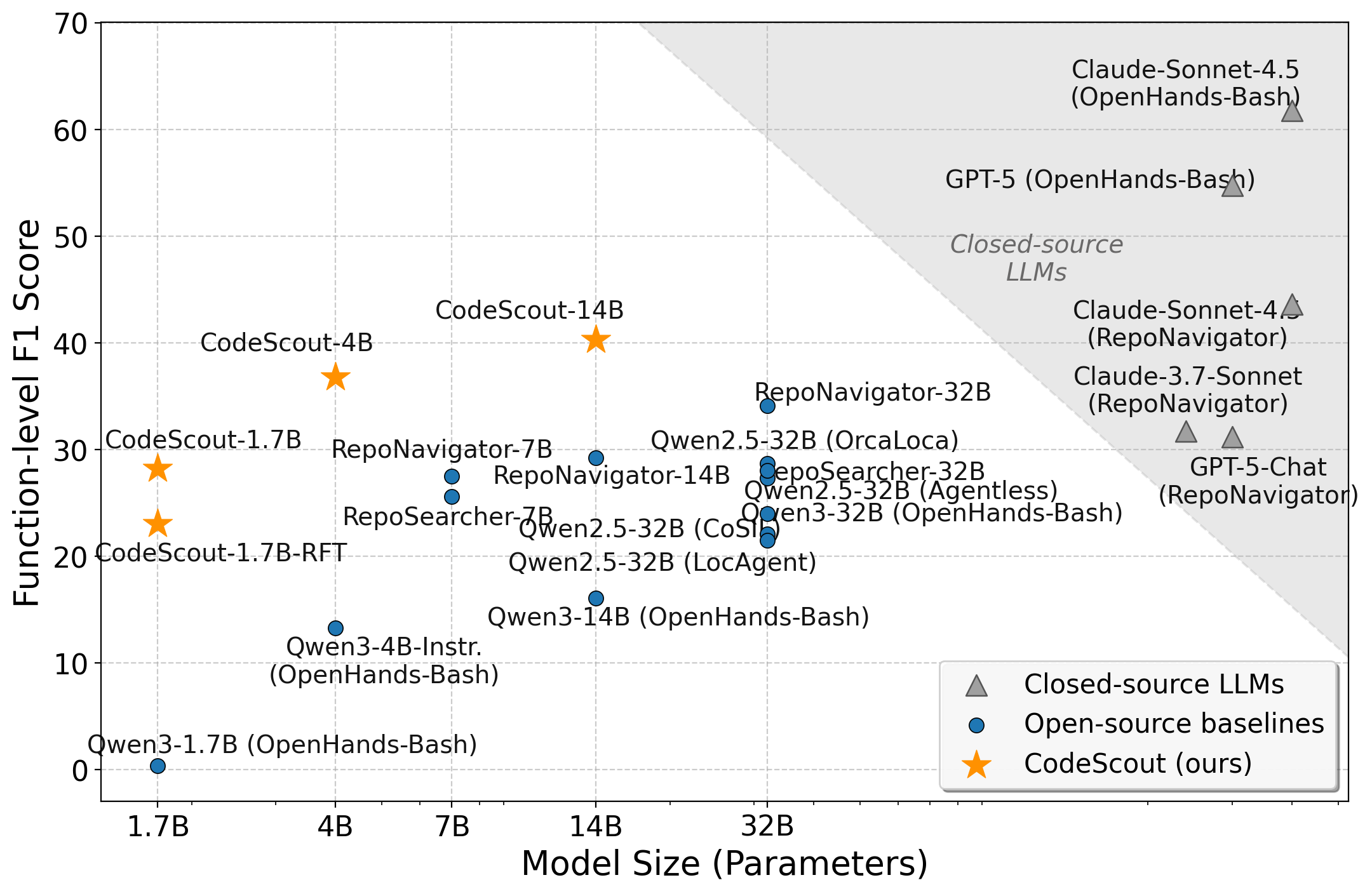
- Outperforms 8× larger Qwen3-14B with absolute F1 gains of 11–18% for files and 10–15% for functions
- Competitive with 18× larger Qwen3-32B (Thinking), surpassing it by 3–6% in function F1
- Matches RepoNavigator-7B performance while being 4× smaller
- Demonstrates that RL + distillation can compress strong code search into a 1.7B model
Results
Performance on SWE-Bench code localization (instance-averaged F1 scores):
| Benchmark | CodeScout-1.7B | CodeScout-4B | CodeScout-14B |
|---|---|---|---|
| SWE-Bench Verified — File F1 | 55.46 | 68.52 | 68.57 |
| SWE-Bench Verified — Func F1 | 28.22 | 36.78 | 40.32 |
| SWE-Bench Pro — File F1 | 40.96 | 51.77 | 53.63 |
| SWE-Bench Pro — Func F1 | 18.24 | 29.03 | 28.74 |
| SWE-Bench Lite — File F1 | 56.57 | 67.03 | 71.84 |
| SWE-Bench Lite — Func F1 | 27.07 | 39.87 | 44.43 |
Code localization performance on SWE-Bench Verified. CodeScout (⭐) achieves superior or competitive results over larger open-source LLMs and narrows the gap with closed-source frontier models.
Training
CodeScout-1.7B is trained in two stages:
Stage 1 — Rejection Fine-Tuning (RFT): Qwen3-1.7B is warm-started via supervised fine-tuning on 4K perfect-score trajectories (F1 = 1.0 at all granularities) sampled from CodeScout-14B, yielding the CodeScout-1.7B-RFT checkpoint.
Stage 2 — RL Training: CodeScout-1.7B-RFT is further trained with GSPO reinforcement learning.
- Training data (RL): 800 instances (disjoint from RFT data)
- RL steps: 100
- Batch size: 8, with 8 rollouts per instance
- Max context length: 32K tokens
- Max turns per episode: 4
- Reward: Multi-level F1 (file + module + function)
- Hardware: 8×H100 GPUs
- Learning rate: 1e-6 (constant)
How It Works
CodeScout uses the OpenHands-Bash scaffold — an agent equipped with only a Terminal tool (supporting standard Unix commands like rg, find, grep, ls) and a LocalizationFinish tool for structured output submission. The agent iteratively navigates the repository to identify relevant files, classes, and functions related to a given issue.
The model is trained with GSPO (Group Sequence Policy Optimization) using multi-level F1 rewards at the file, module, and function level.
Intended Use
CodeScout-1.7B is designed for repository-level code localization: given a GitHub issue description and a code repository, it identifies the relevant files, classes, and functions that need to be modified. It is intended to be used as a localization subagent within larger coding agent pipelines.
Limitations
- Trained and evaluated exclusively on Python repositories
- Designed for code localization, not code editing or issue resolution
- Performance may vary on repositories significantly different from the training distribution
- Requires the OpenHands-Bash scaffold for optimal performance
Citation
@misc{sutawika2026codescouteffectiverecipereinforcement,
title={CodeScout: An Effective Recipe for Reinforcement Learning of Code Search Agents},
author={Lintang Sutawika and Aditya Bharat Soni and Bharath Sriraam R R and Apurva Gandhi and Taha Yassine and Sanidhya Vijayvargiya and Yuchen Li and Xuhui Zhou and Yilin Zhang and Leander Melroy Maben and Graham Neubig},
year={2026},
eprint={2603.17829},
archivePrefix={arXiv},
primaryClass={cs.SE},
url={https://arxiv.org/abs/2603.17829},
}
- Downloads last month
- 249
Install from pip and serve model
# Install vLLM from pip: pip install vllm# Start the vLLM server: vllm serve "OpenHands/CodeScout-1.7B"# Call the server using curl (OpenAI-compatible API): curl -X POST "http://localhost:8000/v1/chat/completions" \ -H "Content-Type: application/json" \ --data '{ "model": "OpenHands/CodeScout-1.7B", "messages": [ { "role": "user", "content": "What is the capital of France?" } ] }'