

problem stringlengths 2 5.64k | solution stringlengths 2 13.5k | answer stringlengths 1 43 | problem_type stringclasses 8
values | question_type stringclasses 4
values | problem_is_valid stringclasses 1
value | solution_is_valid stringclasses 1
value | source stringclasses 6
values | synthetic bool 1
class |
|---|---|---|---|---|---|---|---|---|
Problem 4. A $5 \times 100$ table is divided into 500 unit square cells, where $n$ of them are coloured black and the rest are coloured white. Two unit square cells are called adjacent if they share a common side. Each of the unit square cells has at most two adjacent black unit square cells. Find the largest possible... |
Solution. If we colour all the cells along all edges of the board together with the entire middle row except the second and the last-but-one cell, the condition is satisfied and there are 302 black cells. The figure below exhibits this colouring for the $5 \times 8$ case.
 No number contains the digit 0 .
(2) The sum of the digits of each number is 9 .
(3) The units digits of any two numbers are different.
(4) The tens digits of any two numbers are different.
(5) The hundreds digits of any two numbers are ... |
Solution. Let $S$ denote the set of three-digit numbers that have digit sum equal to 9 and no digit equal to 0 . We will first find the cardinality of $S$. We start from the number 111 and each element of $S$ can be obtained from 111 by a string of 6 A's (which means that we add 1 to the current digit) and $2 G$ 's (w... | 5 | Combinatorics | math-word-problem | Yes | Yes | olympiads | false |
## Problem 2
Let the circles $k_{1}$ and $k_{2}$ intersect at two distinct points $A$ and $B$, and let $t$ be a common tangent of $k_{1}$ and $k_{2}$, that touches $k_{1}$ and $k_{2}$ at $M$ and $N$, respectively. If $t \perp A M$ and $M N=2 A M$, evaluate $\angle N M B$.
| ## Solution 1
Let $P$ be the symmetric of $A$ with respect to $M$ (Figure 1). Then $A M=M P$ and $t \perp A P$, hence the triangle $A P N$ is isosceles with $A P$ as its base, so $\angle N A P=\angle N P A$. We have $\angle B A P=\angle B A M=\angle B M N$ and $\angle B A N=\angle B N M$.
Thus we have
$$
180^{\circ}... | 45 | Geometry | math-word-problem | Yes | Yes | olympiads | false |
Problem 2. For any set $A=\left\{x_{1}, x_{2}, x_{3}, x_{4}, x_{5}\right\}$ of five distinct positive integers denote by $S_{A}$ the sum of its elements, and denote by $T_{A}$ the number of triples $(i, j, k)$ with $1 \leqslant i<j<k \leqslant 5$ for which $x_{i}+x_{j}+x_{k}$ divides $S_{A}$.
Find the largest possibl... |
Solution. We will prove that the maximum value that $T_{A}$ can attain is 4 . Let $A=$ $\left\{x_{1}, x_{2}, x_{3}, x_{4}, x_{5}\right\}$ be a set of five positive integers such that $x_{1}x_{4}$ and $x_{3}>x_{2}$. Analogously we can show that any triple of form $(x, y, 5)$ where $y>2$ isn't good.
By above, the numbe... | 4 | Combinatorics | math-word-problem | Yes | Yes | olympiads | false |
Problem 4. Let $M$ be a subset of the set of 2021 integers $\{1,2,3, \ldots, 2021\}$ such that for any three elements (not necessarily distinct) $a, b, c$ of $M$ we have $|a+b-c|>10$. Determine the largest possible number of elements of $M$.
|
Solution. The set $M=\{1016,1017, \ldots, 2021\}$ has 1006 elements and satisfies the required property, since $a, b, c \in M$ implies that $a+b-c \geqslant 1016+1016-2021=11$. We will show that this is optimal.
Suppose $M$ satisfies the condition in the problem. Let $k$ be the minimal element of $M$. Then $k=|k+k-k|... | 1006 | Combinatorics | math-word-problem | Yes | Yes | olympiads | false |
Problem 2. Let $a, b, c$ be positive real numbers such that $a+b+c=3$. Find the minimum value of the expression
$$
A=\frac{2-a^{3}}{a}+\frac{2-b^{3}}{b}+\frac{2-c^{3}}{c}
$$
$19^{\text {th ... | ## Solution:
We can rewrite $A$ as follows:
$$
\begin{aligned}
& A=\frac{2-a^{3}}{a}+\frac{2-b^{3}}{b}+\frac{2-c^{3}}{c}=2\left(\frac{1}{a}+\frac{1}{b}+\frac{1}{c}\right)-a^{2}-b^{2}-c^{2}= \\
& 2\left(\frac{a b+b c+c a}{a b c}\right)-\left(a^{2}+b^{2}+c^{2}\right)=2\left(\frac{a b+b c+c a}{a b c}\right)-\left((a+b+c... | 3 | Inequalities | math-word-problem | Yes | Yes | olympiads | false |
C1. Consider a regular $2 n+1$-gon $P$ in the plane, where $n$ is a positive integer. We say that a point $S$ on one of the sides of $P$ can be seen from a point $E$ that is external to $P$, if the line segment $S E$ contains no other points that lie on the sides of $P$ except $S$. We want to color the sides of $P$ in... |
Solution. Answer: $n=1$ is clearly a solution, we can just color each side of the equilateral triangle in a different color, and the conditions are satisfied. We prove there is no larger $n$ that fulfills the requirements.
Lemma 1. Given a regular $2 n+1$-gon in the plane, and a sequence of $n+1$ consecutive sides $s... | 1 | Combinatorics | math-word-problem | Yes | Yes | olympiads | false |
NT5. Find all positive integers $n$ such that there exists a prime number $p$, such that
$$
p^{n}-(p-1)^{n}
$$
is a power of 3 .
Note. A power of 3 is a number of the form $3^{a}$ where $a$ is a positive integer.
|
Solution. Suppose that the positive integer $n$ is such that
$$
p^{n}-(p-1)^{n}=3^{a}
$$
for some prime $p$ and positive integer $a$.
If $p=2$, then $2^{n}-1=3^{a}$ by $(1)$, whence $(-1)^{n}-1 \equiv 0(\bmod 3)$, so $n$ should be even. Setting $n=2 s$ we obtain $\left(2^{s}-1\right)\left(2^{s}+1\right)=3^{a}$. It ... | 2 | Number Theory | math-word-problem | Yes | Yes | olympiads | false |
A5. Find the largest positive integer $n$ for which the inequality
$$
\frac{a+b+c}{a b c+1}+\sqrt[n]{a b c} \leq \frac{5}{2}
$$
holds for all $a, b, c \in[0,1]$. Here $\sqrt[1]{a b c}=a b c$.
|
Solution. Let $n_{\max }$ be the sought largest value of $n$, and let $E_{a, b, c}(n)=\frac{a+b+c}{a b c+1}+\sqrt[n]{a b c}$. Then $E_{a, b, c}(m)-E_{a, b, c}(n)=\sqrt[m]{a b c}-\sqrt[n]{a b c}$ and since $a . b c \leq 1$ we clearly have $E_{a, b, c}(m) \geq$ $E_{a, b, c}(n)$ for $m \geq n$. So if $E_{a, b, c}(n) \geq... | 3 | Inequalities | math-word-problem | Yes | Yes | olympiads | false |
G4. Let $A B C$ be an acute-angled triangle with circumcircle $\Gamma$, and let $O, H$ be the triangle's circumcenter and orthocenter respectively. Let also $A^{\prime}$ be the point where the angle bisector of angle $B A C$ meets $\Gamma$. If $A^{\prime} H=A H$, find the measure of angle $B A C$.
, then $\angle B O A=$ $2 y$, and since $O A=O B$, it is $\angle O A B=\angle O B A=90^{\circ}-y$. Also since $A H \perp B C$, it is
$\angle H A C=90^{\circ}-y=\angle O A B$ and the claim follows.
Since $A . A^{\prime}$ bisect... | 60 | Geometry | math-word-problem | Yes | Yes | olympiads | false |
## A1 MLD
Let $x, y, z$ be real numbers, satisfying the relations
$$
\left\{\begin{array}{l}
x \geq 20 \\
y \geq 40 \\
z \geq 1675 \\
x+y+z=2015
\end{array}\right.
$$
Find the greatest value of the product $P=x \cdot y \cdot z$.
| ## Solution 1:
By virtue of $z \geq 1675$ we have
$$
y+z<2015 \Leftrightarrow y<2015-z \leq 2015-1675<1675
$$
It follows that $(1675-y) \cdot(1675-z) \leq 0 \Leftrightarrow y \cdot z \leq 1675 \cdot(y+z-1675)$.
By using the inequality $u \cdot v \leq\left(\frac{u+v}{2}\right)^{2}$ for all real numbers $u, v$ we obt... | 48407500 | Algebra | math-word-problem | Yes | Yes | olympiads | false |
## A2 ALB
3) If $x^{3}-3 \sqrt{3} x^{2}+9 x-3 \sqrt{3}-64=0$, find the value of $x^{6}-8 x^{5}+13 x^{4}-5 x^{3}+49 x^{2}-137 x+2015$.
|
Solution
$x^{3}-3 \sqrt{3} x^{2}+9 x-3 \sqrt{3}-64=0 \Leftrightarrow(x-\sqrt{3})^{3}=64 \Leftrightarrow(x-\sqrt{3})=4 \Leftrightarrow x-4=\sqrt{3} \Leftrightarrow x^{2}-8 x+16=3 \Leftrightarrow$ $x^{2}-8 x+13=0$
$x^{6}-8 x^{5}+13 x^{4}-5 x^{3}+49 x^{2}-137 x+2015=\left(x^{2}-8 x+13\right)\left(x^{4}-5 x+9\right)+189... | 1898 | Algebra | math-word-problem | Yes | Yes | olympiads | false |
## A3 MNE
Let $a, b, c$ be positive real numbers. Prove that
$$
\frac{a}{b}+\sqrt{\frac{b}{c}}+\sqrt[3]{\frac{c}{a}}>2
$$
| ## Solution:
Starting from the double expression on the left-hand side of given inequality, and applying twice the Arithmetic-Geometric mean inequality, we find that
$$
\begin{aligned}
2 \frac{a}{b}+2 \sqrt{\frac{b}{c}}+2 \sqrt[3]{\frac{c}{a}} & =\frac{a}{b}+\left(\frac{a}{b}+\sqrt{\frac{b}{c}}+\sqrt{\frac{b}{c}}\rig... | 4 | Inequalities | proof | Yes | Yes | olympiads | false |
NT1 SAU
What is the greatest number of integers that can be selected from a set of 2015 consecutive numbers so that no sum of any two selected numbers is divisible by their difference?
| ## Solution:
We take any two chosen numbers. If their difference is 1 , it is clear that their sum is divisible by their difference. If their difference is 2 , they will be of the same parity, and their sum is divisible by their difference. Therefore, the difference between any chosen numbers will be at least 3 . In o... | 672 | Number Theory | math-word-problem | Yes | Yes | olympiads | false |
## C3 ALB
Positive integers are put into the following table
| 1 | 3 | 6 | 10 | 15 | 21 | 28 | 36 | | |
| ---: | ---: | ---: | ---: | ---: | ---: | ---: | ---: | ---: | ---: |
| 2 | 5 | 9 | 14 | 20 | 27 | 35 | 44 | | |
| 4 | 8 | 13 | 19 | 26 | 34 | 43 | 53 | | |
| 7 | 12 | 18 | 25 | 33 | 42 | | | | |
| 11 |... | ## Solution 1:
We shall observe straights lines as on the next picture. We can call these lines diagonals.
| 1 | $\sqrt{3}$ | 6 | 10 | 15 | 21 | 28 | 36 | |
| :---: | :---: | :---: | :---: | :---: | :---: | :---: | :---: | :---: |
| 2 | 5 | 9 | 14 | 20 | 27 | 35 | 44 | |
| 4 | 8 | 13 | 19 | 26 | 34 | 43 | 53 | |
|... | 2015 | Number Theory | math-word-problem | Yes | Yes | olympiads | false |
C2 Consider 50 points in the plane, no three of them belonging to the same line. The points have been colored into four colors. Prove that there are at least 130 scalene triangles whose vertices are colored in the same color.
| ## Solution
Since $50=4 \cdot 12+2$, according to the pigeonhole principle we will have at least 13 points colored in the same color. We start with the:
Lemma. Given $n>8$ points in the plane, no three of them collinear, then there are at least $\frac{n(n-1)(n-8)}{6}$ scalene triangles with vertices among the given p... | 130 | Combinatorics | proof | Yes | Yes | olympiads | false |
G2 Let $A B C D$ be a convex quadrilateral with $\varangle D A C=\varangle B D C=36^{\circ}, \varangle C B D=18^{\circ}$ and $\varangle B A C=72^{\circ}$. If $P$ is the point of intersection of the diagonals $A C$ and $B D$, find the measure of $\varangle A P D$.
| ## Solution
On the rays ( $D A$ and ( $B A$ we take points $E$ and $Z$, respectively, such that $A C=A E=$ $A Z$. Since $\varangle D E C=\frac{\varangle D A C}{2}=18^{\circ}=\varangle C B D$, the quadrilateral $D E B C$ is cyclic.
Similarly, the quadrilateral $C B Z D$ is cyclic, because $\varangle A Z C=\frac{\varan... | 108 | Geometry | math-word-problem | Yes | Yes | olympiads | false |
## A1
For any real number a, let $\lfloor a\rfloor$ denote the greatest integer not exceeding a. In positive real numbers solve the following equation
$$
n+\lfloor\sqrt{n}\rfloor+\lfloor\sqrt[3]{n}\rfloor=2014
$$
|
Solution1. Obviously $n$ must be positive integer. Now note that $44^{2}=19362000$ than $2014=n+\lfloor\sqrt{n}\rfloor+\lfloor\sqrt[3]{n}\rfloor>2000+44+12=2056$, a contradiction!
So $1950 \leq n \leq 2000$, therefore $\lfloor\sqrt{n}\rfloor=44$ and $\lfloor\sqrt[3]{n}\rfloor=12$. Plugging that into the original equa... | 1956 | Number Theory | math-word-problem | Yes | Yes | olympiads | false |
## C2
In a country with $n$ cities, all direct airlines are two-way. There are $r>2014$ routes between pairs of different cities that include no more than one intermediate stop (the direction of each route matters). Find the least possible $n$ and the least possible $r$ for that value of $n$.
|
Solution. Denote by $X_{1}, X_{2}, \ldots X_{n}$ the cities in the country and let $X_{i}$ be connected to exactly $m_{i}$ other cities by direct two-way airline. Then $X_{i}$ is a final destination of $m_{i}$ direct routes and an intermediate stop of $m_{i}\left(m_{i}-1\right)$ non-direct routes. Thus $r=m_{1}^{2}+\l... | 2016 | Combinatorics | math-word-problem | Yes | Yes | olympiads | false |
## C4
Let $A=1 \cdot 4 \cdot 7 \cdot \ldots \cdot 2014$ be the product of the numbers less or equal to 2014 that give remainder 1 when divided by 3 . Find the last non-zero digit of $A$.
|
Solution. Grouping the elements of the product by ten we get:
$$
\begin{aligned}
& (30 k+1)(30 k+4)(30 k+7)(30 k+10)(30 k+13)(30 k+16) \\
& (30 k+19)(30 k+22)(30 k+25)(30 k+28)= \\
& =(30 k+1)(15 k+2)(30 k+7)(120 k+40)(30 k+13)(15 k+8) \\
& (30 k+19)(15 k+11)(120 k+100)(15 k+14)
\end{aligned}
$$
(We divide all even ... | 2 | Number Theory | math-word-problem | Yes | Yes | olympiads | false |
A3. Let $A$ and $B$ be two non-empty subsets of $X=\{1,2, \ldots, 11\}$ with $A \cup B=X$. Let $P_{A}$ be the product of all elements of $A$ and let $P_{B}$ be the product of all elements of $B$. Find the minimum and maximum possible value of $P_{A}+P_{B}$ and find all possible equality cases.
|
Solution. For the maximum, we use the fact that $\left(P_{A}-1\right)\left(P_{B}-1\right) \geqslant 0$, to get that $P_{A}+P_{B} \leqslant P_{A} P_{B}+1=11!+1$. Equality holds if and only if $A=\{1\}$ or $B=\{1\}$.
For the minimum observe, first that $P_{A} \cdot P_{B}=11!=c$. Without loss of generality let $P_{A} \l... | 12636 | Combinatorics | math-word-problem | Yes | Yes | olympiads | false |
C3. In a $5 \times 100$ table we have coloured black $n$ of its cells. Each of the 500 cells has at most two adjacent (by side) cells coloured black. Find the largest possible value of $n$.
|
Solution. If we colour all the cells along all edges of the board together with the entire middle row except the second and the last-but-one cell, the condition is satisfied and there are 302 black cells. The figure below exhibits this colouring for the $5 \times 8$ case.
}{2}=7 k$. This is possible only if $n \equiv 0,1 \bmod 7$.
- In order to obtain $n=7 m+1$, arrange the kids in a circ... | 26 | Combinatorics | math-word-problem | Yes | Yes | olympiads | false |
G2 Let $A D, B F$ and $C E$ be the altitudes of $\triangle A B C$. A line passing through $D$ and parallel to $A B$ intersects the line $E F$ at the point $G$. If $H$ is the orthocenter of $\triangle A B C$, find the angle $\widehat{C G H}$.
| ## Solution 1
We can see easily that points $C, D, H, F$ lies on a circle of diameter $[C H]$.
Take $\left\{F, G^{\prime}\right\}=\odot(C H F) \cap E F$. We have $\widehat{E F H}=\widehat{B A D}=\widehat{B C E}=\widehat{D F H}$ since the quadrilaterals $A E D C, A E H F, C D H F$ are cyclic. Hence $[F B$ is the bisec... | 90 | Geometry | math-word-problem | Yes | Yes | olympiads | false |
G3 Let $A B C$ be a triangle in which ( $B L$ is the angle bisector of $\widehat{A B C}(L \in A C), A H$ is an altitude of $\triangle A B C(H \in B C)$ and $M$ is the midpoint of the side $[A B]$. It is known that the midpoints of the segments $[B L]$ and $[M H]$ coincides. Determine the internal angles of triangle $\... | ## Solution
Let $N$ be the intersection of the segments $[B L]$ and $[M H]$. Because $N$ is the midpoint of both segments $[B L]$ and $[M H]$, it follows that $B M L H$ is a parallelogram. This implies that $M L \| B C$ and $L H \| A B$ and hence, since $M$ is the midpoint of $[A B]$, the angle bisector [ $B L$ and th... | 60 | Geometry | math-word-problem | Yes | Yes | olympiads | false |
C2. Given $m \times n$ table, each cell signed with "-". The following operations are
(i) to change all the signs in entire row to the opposite, i. e. every "-" to "+", and every "+" to "-";
(ii) to change all the signs in entire column to the opposite, i. e. every "-" to "+" and every "+" to " -".
(a) Prove that i... |
Solution. If we apply (i) to $l$ rows and (ii) to $k$ columns we obtain $(m-k) l+(n-l) k$
(a) We have equation $(100-k) l+(100-l) k=2004$, or $100 l+100 k-2 l k=2004$, le
$$
50 l+50 k-1 k=1002
$$
Rewrite the lasc equation as
$$
(50-l)(50-h)=2.500-100.2=1498
$$
Since $1498=2 \cdot 7 \cdot 107$, this equation has n... | 102 | Combinatorics | proof | Yes | Yes | olympiads | false |
Problem A2. Determine all four digit numbers $\overline{a b c d}$ such that
$$
a(a+b+c+d)\left(a^{2}+b^{2}+c^{2}+d^{2}\right)\left(a^{6}+2 b^{6}+3 c^{6}+4 d^{6}\right)=\overline{a b c d}
$$
|
Solution. From $\overline{a b c d}\overline{1 b c d}=(1+b+c+d)\left(1+b^{2}+c^{2}+d^{2}\right)\left(1+2 b^{6}+3 c^{6}+4 d^{6}\right) \geq$ $(b+1)\left(b^{2}+1\right)\left(2 b^{6}+1\right)$, so $b \leq 2$. Similarly one gets $c\overline{2 b c d}=2(2+b+c+d)\left(4+b^{2}+c^{2}+d^{2}\right)\left(64+2 b^{6}+3 c^{6}+4 d^{6}... | 2010 | Number Theory | math-word-problem | Yes | Yes | olympiads | false |
Problem G2. Consider a triangle $A B C$ and let $M$ be the midpoint of the side $B C$. Suppose $\angle M A C=\angle A B C$ and $\angle B A M=105^{\circ}$. Find the measure of $\angle A B C$.
|
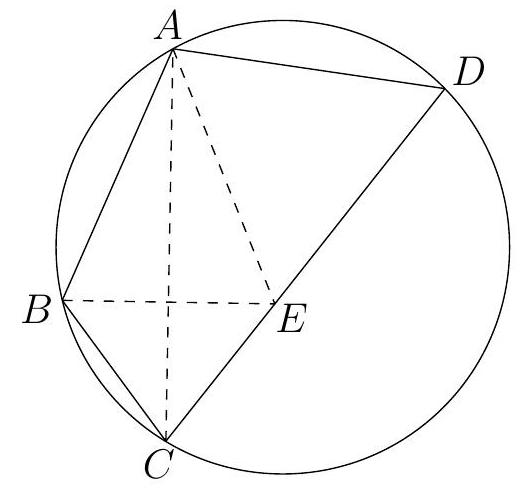
Solution. The angle measure is $30^{\circ}$.
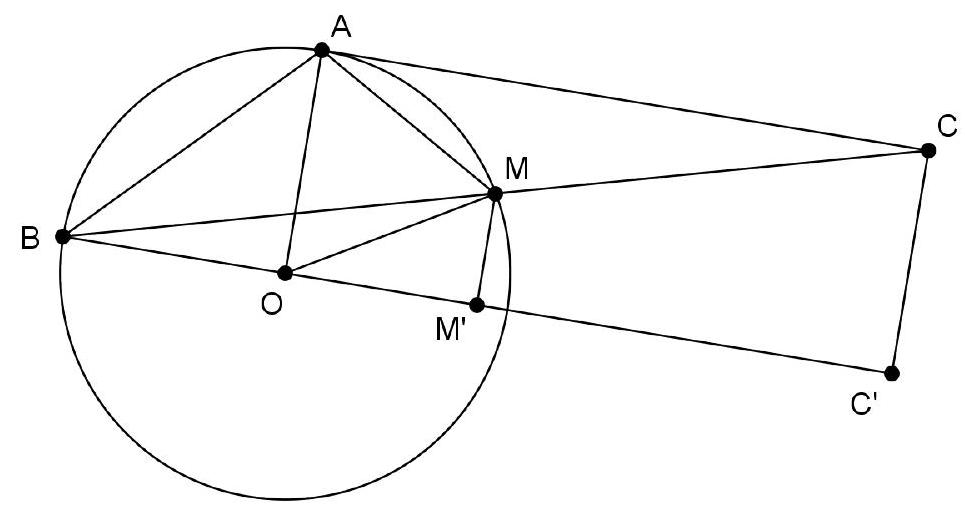
Let $O$ be the circumcenter of the triangle $A B M$. From $\angle B A M=105^{\circ}$ follows $\angle M B O=15^{\circ}$. Let $M^{\prime}, C^{\pri... | 30 | Geometry | math-word-problem | Yes | Yes | olympiads | false |
Problem N2. Find all positive integers $n$ such that $36^{n}-6$ is a product of two or more consecutive positive integers.
|
Solution. Answer: $n=1$.
Among each four consecutive integers there is a multiple of 4 . As $36^{n}-6$ is not a multiple of 4 , it must be the product of two or three consecutive positive integers.
Case I. If $36^{n}-6=x(x+1)$ (all letters here and below denote positive integers), then $4 \cdot 36^{n}-23=(2 x+1)^{2}... | 1 | Number Theory | math-word-problem | Yes | Yes | olympiads | false |
A1. Let $a, b, c$ be positive real numbers such that $a b c=8$. Prove that
$$
\frac{a b+4}{a+2}+\frac{b c+4}{b+2}+\frac{c a+4}{c+2} \geq 6
$$
|
Solution. We have $a b+4=\frac{8}{c}+4=\frac{4(c+2)}{c}$ and similarly $b c+4=\frac{4(a+2)}{a}$ and $c a+4=\frac{4(b+2)}{b}$. It follows that
$$
(a b+4)(b c+4)(c a+4)=\frac{64}{a b c}(a+2)(b+2)(c+2)=8(a+2)(b+2)(c+2)
$$
so that
$$
\frac{(a b+4)(b c+4)(c a+4)}{(a+2)(b+2)(c+2)}=8
$$
Applying AM-GM, we conclude:
$$
\... | 6 | Inequalities | proof | Yes | Yes | olympiads | false |
A3. Determine the number of pairs of integers $(m, n)$ such that
$$
\sqrt{n+\sqrt{2016}}+\sqrt{m-\sqrt{2016}} \in \mathbb{Q}
$$
|
Solution. Let $r=\sqrt{n+\sqrt{2016}}+\sqrt{m-\sqrt{2016}}$. Then
$$
n+m+2 \sqrt{n+\sqrt{2016}} \cdot \sqrt{m-\sqrt{2016}}=r^{2}
$$
and
$$
(m-n) \sqrt{2106}=\frac{1}{4}\left(r^{2}-m-n\right)^{2}-m n+2016 \in \mathbb{Q}
$$
Since $\sqrt{2016} \notin \mathbb{Q}$, it follows that $m=n$. Then
$$
\sqrt{n^{2}-2016}=\fra... | 1 | Algebra | math-word-problem | Yes | Yes | olympiads | false |
C1. Let $S_{n}$ be the sum of reciprocal values of non-zero digits of all positive integers up to (and including) $n$. For instance, $S_{13}=\frac{1}{1}+\frac{1}{2}+\frac{1}{3}+\frac{1}{4}+\frac{1}{5}+\frac{1}{6}+\frac{1}{7}+\frac{1}{8}+\frac{1}{9}+\frac{1}{1}+\frac{1}{1}+\frac{1}{1}+\frac{1}{1}+\frac{1}{2}+\frac{1}{1... | ## Solution.
We will first calculate $S_{999}$, then $S_{1999}-S_{999}$, and then $S_{2016}-S_{1999}$.
Writing the integers from 1 to 999 as 001 to 999, adding eventually also 000 (since 0 digits actually do not matter), each digit appears exactly 100 times in each position(as unit, ten, or hundred). Hence
$$
S_{999... | 7 | Number Theory | math-word-problem | Yes | Yes | olympiads | false |
C2. The natural numbers from 1 to 50 are written down on the blackboard. At least how many of them should be deleted, in order that the sum of any two of the remaining numbers is not a prime?
|
Solution. Notice that if the odd, respectively even, numbers are all deleted, then the sum of any two remaining numbers is even and exceeds 2 , so it is certainly not a prime. We prove that 25 is the minimal number of deleted numbers. To this end, we group the positive integers from 1 to 50 in 25 pairs, such that the ... | 25 | Number Theory | math-word-problem | Yes | Yes | olympiads | false |
C3. Consider any four pairwise distinct real numbers and write one of these numbers in each cell of a $5 \times 5$ array so that each number occurs exactly once in every $2 \times 2$ subarray. The sum over all entries of the array is called the total sum of that array. Determine the maximum number of distinct total su... |
Solution. We will prove that the maximum number of total sums is 60 .
The proof is based on the following claim.
Claim. Either each row contains exactly two of the numbers, or each column contains exactly two of the numbers.
Proof of the Claim. Indeed, let $R$ be a row containing at least three of the numbers. Then... | 60 | Combinatorics | math-word-problem | Yes | Yes | olympiads | false |
N1. Determine the largest positive integer $n$ that divides $p^{6}-1$ for all primes $p>7$.
|
Solution. Note that
$$
p^{6}-1=(p-1)(p+1)\left(p^{2}-p+1\right)\left(p^{2}+p+1\right)
$$
For $p=11$ we have
$$
p^{6}-1=1771560=2^{3} \cdot 3^{2} \cdot 5 \cdot 7 \cdot 19 \cdot 37
$$
For $p=13$ we have
$$
p^{6}-1=2^{3} \cdot 3^{2} \cdot 7 \cdot 61 \cdot 157
$$
From the last two calculations we find evidence to tr... | 504 | Number Theory | math-word-problem | Yes | Yes | olympiads | false |
N2. Find the maximum number of natural numbers $x_{1}, x_{2}, \ldots, x_{m}$ satisfying the conditions:
a) No $x_{i}-x_{j}, 1 \leq i<j \leq m$ is divisible by 11 ; and
b) The sum $x_{2} x_{3} \ldots x_{m}+x_{1} x_{3} \ldots x_{m}+\cdots+x_{1} x_{2} \ldots x_{m-1}$ is divisible by 11 .
|
Solution. The required maximum is 10 .
According to a), the numbers $x_{i}, 1 \leq i \leq m$, are all different $(\bmod 11)$ (1)
Hence, the number of natural numbers satisfying the conditions is at most 11.
If $x_{j} \equiv 0(\bmod 11)$ for some $j$, then
$$
x_{2} x_{3} \ldots x_{m}+x_{1} x_{3} \ldots x_{m}+\cdots... | 10 | Number Theory | math-word-problem | Yes | Yes | olympiads | false |
N5. Determine all four-digit numbers $\overline{a b c d}$ such that
$$
(a+b)(a+c)(a+d)(b+c)(b+d)(c+d)=\overline{a b c d}
$$
|
Solution. Depending on the parity of $a, b, c, d$, at least two of the factors $(a+b),(a+c)$, $(a+d),(b+c),(b+d),(c+d)$ are even, so that $4 \mid \overline{a b c d}$.
We claim that $3 \mid \overline{a b c d}$.
Assume $a+b+c+d \equiv 2(\bmod 3)$. Then $x+y \equiv 1(\bmod 3)$, for all distinct $x, y \in\{a, b, c, d\}$... | 2016 | Number Theory | math-word-problem | Yes | Yes | olympiads | false |
NT 3. Find the largest integer $k(k \geq 2)$, for which there exists an integer $n(n \geq k)$ such that from any collection of $n$ consecutive positive integers one can always choose $k$ numbers, which verify the following conditions:
1. each chosen number is not divisible by 6 , by 7 and by 8 ;
2. the positive diffe... |
Solution. An integer is divisible by 6,7 and 8 if and only if it is divisible by their Least Common Multiple, which equals $6 \times 7 \times 4=168$.
Let $n$ be a positive integer and let $A$ be an arbitrary set of $n$ consecutive positive integers. Replace each number $a_{i}$ from $A$ with its remainder $r_{i}$ ( mo... | 108 | Number Theory | math-word-problem | Yes | Yes | olympiads | false |
A 2. Find the maximum positive integer $k$ such that for any positive integers $m, n$ such that $m^{3}+n^{3}>$ $(m+n)^{2}$, we have
$$
m^{3}+n^{3} \geq(m+n)^{2}+k
$$
|
Solution. We see that for $m=3$ and $n=2$ we have $m^{3}+n^{3}>(m+n)^{2}$, thus
$$
3^{3}+2^{3} \geq(3+2)^{2}+k \Rightarrow k \leq 10
$$
We will show that $k=10$ is the desired maximum. In other words, we have to prove that
$$
m^{3}+n^{3} \geq(m+n)^{2}+10
$$
The last inequality is equivalent to
$$
(m+n)\left(m^{2}... | 10 | Inequalities | math-word-problem | Yes | Yes | olympiads | false |
A 4. Let $k>1, n>2018$ be positive integers, and let $n$ be odd. The nonzero rational numbers $x_{1}$, $x_{2}, \ldots, x_{n}$ are not all equal and satisfy
$$
x_{1}+\frac{k}{x_{2}}=x_{2}+\frac{k}{x_{3}}=x_{3}+\frac{k}{x_{4}}=\cdots=x_{n-1}+\frac{k}{x_{n}}=x_{n}+\frac{k}{x_{1}}
$$
Find:
a) the product $x_{1} x_{2} \... |
Solution. a) If $x_{i}=x_{i+1}$ for some $i$ (assuming $x_{n+1}=x_{1}$ ), then by the given identity all $x_{i}$ will be equal, a contradiction. Thus $x_{1} \neq x_{2}$ and
$$
x_{1}-x_{2}=k \frac{x_{2}-x_{3}}{x_{2} x_{3}}
$$
Analogously
$$
x_{1}-x_{2}=k \frac{x_{2}-x_{3}}{x_{2} x_{3}}=k^{2} \frac{x_{3}-x_{4}}{\left... | 4 | Algebra | math-word-problem | Yes | Yes | olympiads | false |
A 5. Let $a, b, c, d$ and $x, y, z, t$ be real numbers such that
$$
0 \leq a, b, c, d \leq 1, \quad x, y, z, t \geq 1 \text { and } a+b+c+d+x+y+z+t=8
$$
Prove that
$$
a^{2}+b^{2}+c^{2}+d^{2}+x^{2}+y^{2}+z^{2}+t^{2} \leq 28
$$
When does the equality hold?
|
Solution. We observe that if $u \leq v$ then by replacing $(u, v)$ with $(u-\varepsilon, v+\varepsilon)$, where $\varepsilon>0$, the sum of squares increases. Indeed,
$$
(u-\varepsilon)^{2}+(v+\varepsilon)^{2}-u^{2}-v^{2}=2 \varepsilon(v-u)+2 \varepsilon^{2}>0
$$
Then, denoting
$$
E(a, b, c, d, x, y, z, t)=a^{2}+b^... | 28 | Inequalities | proof | Yes | Yes | olympiads | false |
A 7. Let $A$ be a set of positive integers with the following properties:
(a) If $n$ is an element of $A$ then $n \leqslant 2018$.
(b) If $S$ is a subset of $A$ with $|S|=3$ then there are two elements $n, m$ of $S$ with $|n-m| \geqslant \sqrt{n}+\sqrt{m}$.
What is the maximum number of elements that $A$ can have?
|
Solution. Assuming $n>m$ we have
$$
\begin{aligned}
|n-m| \geqslant \sqrt{n}+\sqrt{m} & \Leftrightarrow(\sqrt{n}-\sqrt{m})(\sqrt{n}+\sqrt{m}) \geqslant \sqrt{n}+\sqrt{m} \\
& \Leftrightarrow \sqrt{n} \geqslant \sqrt{m}+1 .
\end{aligned}
$$
Let $A_{k}=\left\{k^{2}, k^{2}+1, \ldots,(k+1)^{2}-1\right\}$. Note that each... | 88 | Combinatorics | math-word-problem | Yes | Yes | olympiads | false |
C 2. A set $T$ of $n$ three-digit numbers has the following five properties:
(1) No number contains the digit 0 .
(2) The sum of the digits of each number is 9 .
(3) The units digits of any two numbers are different.
(4) The tens digits of any two numbers are different.
(5) The hundreds digits of any two numbers ... |
Solution. Let $S$ denote the set of three-digit numbers that have digit sum equal to 9 and no digit equal to 0 . We will first find the cardinality of $S$. We start from the number 111 and each element of $S$ can be obtained from 111 by a string of $6 A$ 's (which means that we add 1 to the current digit) and 2 G's (w... | 5 | Combinatorics | math-word-problem | Yes | Yes | olympiads | false |
C2 Five players $(A, B, C, D, E)$ take part in a bridge tournament. Every two players must play (as partners) against every other two players. Any two given players can be partners not more than once per day. What is the least number of days needed for this tournament?
|
Solution: A given pair must play with three other pairs and these plays must be in different days, so at three days are needed. Suppose that three days suffice. Let the pair $A B$ play against $C D$ on day $x$. Then $A B-D E$ and $C D-B E$ cannot play on day $x$. Then one of the other two plays of $D E$ (with $A C$ an... | 4 | Combinatorics | math-word-problem | Yes | Yes | olympiads | false |
C3 a) In how many ways can we read the word SARAJEVO from the table below, if it is allowed to jump from cell to an adjacent cell (by vertex or a side) cell?
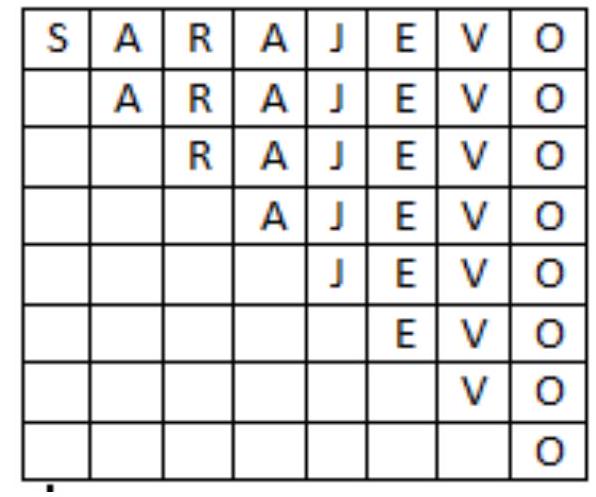
b) After the letter in one cell... |
Solution: In the first of the tables below the number in each cell shows the number of ways to reach that cell from the start (which is the sum of the quantities in the cells, from which we can come), and in the second one are the number of ways to arrive from that cell to the end (which is the sum of the quantities i... | 750 | Combinatorics | math-word-problem | Yes | Yes | olympiads | false |
G2 In a right trapezoid $A B C D(A B \| C D)$ the angle at vertex $B$ measures $75^{\circ}$. Point $H$ is the foot of the perpendicular from point $A$ to the line $B C$. If $B H=D C$ and $A D+A H=8$, find the area of $A B C D$.
|
Solution: Produce the legs of the trapezoid until they intersect at point $E$. The triangles $A B H$ and $E C D$ are congruent (ASA). The area of $A B C D$ is equal to area of triangle $E A H$ of hypotenuse
$$
A E=A D+D E=A D+A H=8
$$
Let $M$ be the midpoint of $A E$. Then
$$
M E=M A=M H=4
$$
and $\angle A M H=30^... | 8 | Geometry | math-word-problem | Yes | Yes | olympiads | false |
NT2 A group of $n>1$ pirates of different age owned total of 2009 coins. Initially each pirate (except for the youngest one) had one coin more than the next younger.
a) Find all possible values of $n$.
b) Every day a pirate was chosen. The chosen pirate gave a coin to each of the other pirates. If $n=7$, find the la... | ## Solution:
a) If $n$ is odd, then it is a divisor of $2009=7 \times 7 \times 41$. If $n>49$, then $n$ is at least $7 \times 41$, while the average pirate has 7 coins, so the initial division is impossible. So, we can have $n=7, n=41$ or $n=49$. Each of these cases is possible (e.g. if $n=49$, the average pirate has ... | 1994 | Number Theory | math-word-problem | Yes | Yes | olympiads | false |
C4 In a group of $n$ people, each one had a different ball. They performed a sequence of swaps; in each swap, two people swapped the ball they had at that moment. Each pair of people performed at least one swap. In the end each person had the ball he/she had at the start. Find the least possible number of swaps, if: $... | ## Solution
We will denote the people by $A, B, C, \ldots$ and their initial balls by the corresponding small letters. Thus the initial state is $A a, B b, C c, D d, E e(, F f)$. A swap is denoted by the (capital) letters of the people involved.
a) Five people form 10 pairs, so at least 10 swaps are necessary.
In fa... | 16 | Combinatorics | math-word-problem | Yes | Yes | olympiads | false |
C5 A set $S$ of natural numbers is called good, if for each element $x \in S, x$ does not divide the sum of the remaining numbers in $S$. Find the maximal possible number of elements of a good set which is a subset of the set $A=\{1,2,3, \ldots, 63\}$.
|
Solution
Let set $B$ be the good subset of $A$ which have the maximum number of elements. We can easily see that the number 1 does not belong to $B$ since 1 divides all natural numbers. Based on the property of divisibility, we know that $x$ divides the sum of the remaining numbers if and only if $x$ divides the sum ... | 61 | Number Theory | math-word-problem | Yes | Yes | olympiads | false |
G3. Let $A B C D E F$ be a regular hexagon. The points $\mathrm{M}$ and $\mathrm{N}$ are internal points of the sides $\mathrm{DE}$ and $\mathrm{DC}$ respectively, such that $\angle A M N=90^{\circ}$ and $A N=\sqrt{2} \cdot C M$. Find the measure of the angle $\angle B A M$.
| ## Solution
Since $A C \perp C D$ and $A M \perp M N$ the quadrilateral $A M N C$ is inscribed. So, we have
$$
\angle M A N=\angle M C N
$$
Let $P$ be the projection of the point $M$ on the line $C D$. The triangles $A M N$ and $C P M$ are similar implying
$$
\frac{A M}{C P}=\frac{M N}{P M}=\frac{A N}{C M}=\sqrt{2}... | 75 | Geometry | math-word-problem | Yes | Yes | olympiads | false |
G6. A point $O$ and the circles $k_{1}$ with center $O$ and radius $3, k_{2}$ with center $O$ and radius 5, are given. Let $A$ be a point on $k_{1}$ and $B$ be a point on $k_{2}$. If $A B C$ is equilateral triangle, find the maximum value of the distance $O C$.
| ## Solution
It is easy to see that the points $O$ and $C$ must be in different semi-planes with respect to the line $A B$.
Let $O P B$ be an equilateral triangle ( $P$ and $C$ on the same side of $O B$ ). Since $\angle P B C$ $=60^{\circ}-\angle A B P$ and $\angle O B A=60^{\circ}-\angle A B P$, then $\angle P B C=\a... | 8 | Geometry | math-word-problem | Yes | Yes | olympiads | false |
NT2. Find all natural numbers $n$ such that $5^{n}+12^{n}$ is perfect square.
| ## Solution
By checking the cases $n=1,2,3$ we get the solution $n=2$ and $13^{2}=5^{2}+12^{2}$.
If $n=2 k+1$ is odd, we consider the equation modulo 5 and we obtain
$$
\begin{aligned}
x^{2} & \equiv 5^{2 k+1}+12^{2 k+1}(\bmod 5) \equiv 2^{2 k} \cdot 2(\bmod 5) \\
& \equiv(-1)^{k} \cdot 2(\bmod 5) \equiv \pm 2(\bmod... | 2 | Number Theory | math-word-problem | Yes | Yes | olympiads | false |
A4 Let $x, y$ be positive real numbers such that $x^{3}+y^{3} \leq x^{2}+y^{2}$. Find the greatest possible value of the product $x y$.
| ## Solution 1
We have $(x+y)\left(x^{2}+y^{2}\right) \geq(x+y)\left(x^{3}+y^{3}\right) \geq\left(x^{2}+y^{2}\right)^{2}$, hence $x+y \geq x^{2}+y^{2}$. Now $2(x+y) \geq(1+1)\left(x^{2}+y^{2}\right) \geq(x+y)^{2}$, thus $2 \geq x+y$. Because $x+y \geq 2 \sqrt{x y}$, we will obtain $1 \geq x y$. Equality holds when $x=y... | 1 | Inequalities | math-word-problem | Yes | Yes | olympiads | false |
A6 Let $x_{i}>1$, for all $i \in\{1,2,3, \ldots, 2011\}$. Prove the inequality $\sum_{i=1}^{2011} \frac{x_{i}^{2}}{x_{i+1}-1} \geq 8044$ where $x_{2012}=x_{1}$. When does equality hold?
| ## Solution 1
Realize that $\left(x_{i}-2\right)^{2} \geq 0 \Leftrightarrow x_{i}^{2} \geq 4\left(x_{i}-1\right)$. So we get:
$\frac{x_{1}^{2}}{x_{2}-1}+\frac{x_{2}^{2}}{x_{3}-1}+\ldots+\frac{x_{2011}^{2}}{x_{1}-1} \geq 4\left(\frac{x_{1}-1}{x_{2}-1}+\frac{x_{2}-1}{x_{3}-1}+\ldots+\frac{x_{2011}-1}{x_{1}-1}\right)$. ... | 8044 | Inequalities | proof | Yes | Yes | olympiads | false |
A7 Let $a, b, c$ be positive real numbers with $a b c=1$. Prove the inequality:
$$
\frac{2 a^{2}+\frac{1}{a}}{b+\frac{1}{a}+1}+\frac{2 b^{2}+\frac{1}{b}}{c+\frac{1}{b}+1}+\frac{2 c^{2}+\frac{1}{c}}{a+\frac{1}{c}+1} \geq 3
$$
| ## Solution 1
By $A M-G M$ we have $2 x^{2}+\frac{1}{x}=x^{2}+x^{2}+\frac{1}{x} \geq 3 \sqrt[3]{\frac{x^{4}}{x}}=3 x$ for all $x>0$, so we have:
$\sum_{\text {cyc }} \frac{2 a^{2}+\frac{1}{a}}{b+\frac{1}{a}+1} \geq \sum_{c y c} \frac{3 a}{1+b+b c}=3\left(\sum_{c y c} \frac{a^{2}}{1+a+a b}\right) \geq \frac{3(a+b+c)^{... | 3 | Inequalities | proof | Yes | Yes | olympiads | false |
A9 Consider an integer $n \geq 4$ and a sequence of real numbers $x_{1}, x_{2}, x_{3}, \ldots, x_{n}$. An operation consists in eliminating all numbers not having the rank of the form $4 k+3$, thus leaving only the numbers $x_{3}, x_{7}, x_{11}, \ldots$ (for example, the sequence $4,5,9,3,6,6,1,8$ produces the sequenc... | ## Solution
After the first operation 256 number remain; after the second one, 64 are left, then 16, next 4 and ultimately only one number.
Notice that the 256 numbers left after the first operation are $3,7, \ldots, 1023$, hence they are in arithmetical progression of common difference 4. Successively, the 64 number... | 683 | Combinatorics | math-word-problem | Yes | Yes | olympiads | false |
G3 The vertices $A$ and $B$ of an equilateral $\triangle A B C$ lie on a circle $k$ of radius 1 , and the vertex $C$ is inside $k$. The point $D \neq B$ lies on $k, A D=A B$ and the line $D C$ intersects $k$ for the second time in point $E$. Find the length of the segment $C E$.
| ## Solution
As $A D=A C, \triangle C D A$ is isosceles. If $\varangle A D C=\varangle A C D=\alpha$ and $\varangle B C E=\beta$, then $\beta=120^{\circ}-\alpha$. The quadrilateral $A B E D$ is cyclic, so $\varangle A B E=180^{\circ}-\alpha$. Then $\varangle C B E=$ $120^{\circ}-\alpha$ so $\varangle C B E=\beta$. Thus... | 1 | Geometry | math-word-problem | Yes | Yes | olympiads | false |
NT3 Let $s(a)$ denote the sum of digits of a given positive integer $a$. The sequence $a_{1}, a_{2}, \ldots a_{n}, \ldots$ of positive integers is such that $a_{n+1}=a_{n}+s\left(a_{n}\right)$ for each positive integer $n$. Find the greatest possible $n$ for which it is possible to have $a_{n}=2008$.
| ## Solution
Since $a_{n-1} \equiv s\left(a_{n-1}\right)$ (all congruences are modulo 9 ), we have $2 a_{n-1} \equiv a_{n} \equiv 2008 \equiv 10$, so $a_{n-1} \equiv 5$. But $a_{n-1}<2008$, so $s\left(a_{n-1}\right) \leq 28$ and thus $s\left(a_{n-1}\right)$ can equal 5,14 or 23 . We check $s(2008-5)=s(2003)=5, s(2008-1... | 6 | Number Theory | math-word-problem | Yes | Yes | olympiads | false |
NT4 Find all integers $n$ such that $n^{4}+8 n+11$ is a product of two or more consecutive integers.
|
Solution
We will prove that $n^{4}+8 n+11$ is never a multiple of 3 . This is clear if $n$ is a multiple of 3 . If
$n$ is not a multiple of 3 , then $n^{4}+8 n+11=\left(n^{4}-1\right)+12+8 n=(n-1)(n+1)\left(n^{2}+1\right)+12+8 n$, where $8 n$ is the only term not divisible by 3 . Thus $n^{4}+8 n+11$ is never the prod... | 1 | Number Theory | math-word-problem | Yes | Yes | olympiads | false |
NT6 Let $f: \mathbb{N} \rightarrow \mathbb{R}$ be a function, satisfying the following condition:
for every integer $n>1$, there exists a prime divisor $p$ of $n$ such that $f(n)=f\left(\frac{n}{p}\right)-f(p)$. If
$$
f\left(2^{2007}\right)+f\left(3^{2008}\right)+f\left(5^{2009}\right)=2006
$$
determine the value o... | ## Solution
If $n=p$ is prime number, we have
$$
f(p)=f\left(\frac{p}{p}\right)-f(p)=f(1)-f(p)
$$
i.e.
$$
f(p)=\frac{f(1)}{2}
$$
If $n=p q$, where $p$ and $q$ are prime numbers, then
$$
f(n)=f\left(\frac{n}{p}\right)-f(p)=f(q)-f(p)=\frac{f(1)}{2}-\frac{f(1)}{2}=0
$$
If $n$ is a product of three prime numbers, we... | 9 | Number Theory | math-word-problem | Yes | Yes | olympiads | false |
NT7 Determine the minimal prime number $p>3$ for which no natural number $n$ satisfies
$$
2^{n}+3^{n} \equiv 0(\bmod p)
$$
| ## Solution
We put $A(n)=2^{n}+3^{n}$. From Fermat's little theorem, we have $2^{p-1} \equiv 1(\bmod p)$ and $3^{p-1} \equiv 1(\bmod p)$ from which we conclude $A(n) \equiv 2(\bmod p)$. Therefore, after $p-1$ steps
at most, we will have repetition of the power. It means that in order to determine the minimal prime num... | 19 | Number Theory | math-word-problem | Yes | Yes | olympiads | false |
ALG 5. Let $A B C$ be a scalene triangle with $B C=a, A C=b$ and $A B=c$, where $a_{r} b, c$ are positive integers. Prove that
$$
\left|a b^{2}+b c^{2}+c a^{2}-a^{2} b-b^{2} c-c^{2} a\right| \geq 2
$$
|
Solution. Denote $E=a b^{2}+b c^{2}+c a^{2}-a^{2} b-b^{2} c-c^{2} a$. We have
$$
\begin{aligned}
E= & \left(a b c-c^{2} a\right)+\left(c a^{2}-a^{2} b\right)+\left(b c^{2}-b^{2} c\right)+\left(a b^{2}-a b c\right)= \\
& (b-c)\left(a c-a^{2}-b c+a b\right)=(b-c)\left(a a^{2}-b\right)(c-a)
\end{aligned}
$$
So, $|E|=|a... | 2 | Algebra | proof | Yes | Yes | olympiads | false |
87.3. Let $f$ be a strictly increasing function defined in the set of natural numbers satisfying the conditions $f(2)=a>2$ and $f(m n)=f(m) f(n)$ for all natural numbers $m$ and $n$. Determine the smallest possible value of $a$.
|
Solution. Since $f(n)=n^{2}$ is a function satisfying the conditions of the problem, the smallest posiible $a$ is at most 4. Assume $a=3$. It is easy to prove by induction that $f\left(n^{k}\right)=f(n)^{k}$ for all $k \geq 1$. So, taking into account that $f$ is strictly increasing, we get
$$
\begin{gathered}
f(3)^{... | 4 | Algebra | math-word-problem | Yes | Yes | olympiads | false |
88.1. The positive integer $n$ has the following property: if the three last digits of $n$ are removed, the number $\sqrt[3]{n}$ remains. Find $n$.
|
Solution. If $x=\sqrt[3]{n}$, and $y, 0 \leq y1000$, and $x>31$. On the other hand, $x^{3}<1000 x+1000$, or $x\left(x^{2}-1000\right)<1000$. The left hand side of this inequality is an increasing function of $x$, and $x=33$ does not satisfy the inequality. So $x<33$. Since $x$ is an integer, $x=32$ and $n=32^{3}=32768... | 32768 | Number Theory | math-word-problem | Yes | Yes | olympiads | false |
91.1. Determine the last two digits of the number
$$
2^{5}+2^{5^{2}}+2^{5^{3}}+\cdots+2^{5^{1991}}
$$
written in decimal notation.
|
Solution. We first show that all numbers $2^{5^{k}}$ are of the form $100 p+32$. This can be shown by induction. The case $k=1$ is clear $\left(2^{5}=32\right)$. Assume $2^{5^{k}}=100 p+32$. Then, by the binomial formula,
$$
2^{5^{k+1}}=\left(2^{5^{k}}\right)^{5}=(100 p+32)^{5}=100 q+32^{5}
$$
and
$$
\begin{gathere... | 12 | Number Theory | math-word-problem | Yes | Yes | olympiads | false |
92.4. Peter has many squares of equal side. Some of the squares are black, some are white. Peter wants to assemble a big square, with side equal to $n$ sides of the small squares, so that the big square has no rectangle formed by the small squares such that all the squares in the vertices of the rectangle are of equal... |
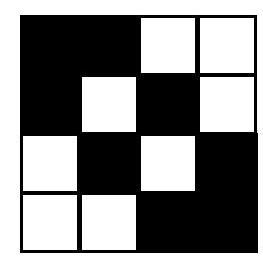
Solution. We show that Peter only can make a $4 \times 4$ square. The construction is possible, if $n=4$ :
Now consider the case $n=5$. We may assume that at least 13 of the 25 squares are ... | 4 | Combinatorics | math-word-problem | Yes | Yes | olympiads | false |
95.2. Messages are coded using sequences consisting of zeroes and ones only. Only sequences with at most two consecutive ones or zeroes are allowed. (For instance the sequence 011001 is allowed, but 011101 is not.) Determine the number of sequences consisting of exactly 12 numbers.
|
Solution 1. Let $S_{n}$ be the set of acceptable sequences consisting of $2 n$ digits. We partition $S_{n}$ in subsets $A_{n}, B_{n}, C_{n}$, and $D_{n}$, on the basis of the two last digits of the sequence. Sequences ending in 00 are in $A_{n}$, those ending in 01 are in $B_{n}$, those ending in 10 are in $C_{n}$, an... | 466 | Combinatorics | math-word-problem | Yes | Yes | olympiads | false |
96.4. The real-valued function $f$ is defined for positive integers, and the positive integer a satisfies
$$
\begin{gathered}
f(a)=f(1995), \quad f(a+1)=f(1996), \quad f(a+2)=f(1997) \\
f(n+a)=\frac{f(n)-1}{f(n)+1} \quad \text { for all positive integers } n
\end{gathered}
$$
(i) Show that $f(n+4 a)=f(n)$ for all po... |
Solution. To prove (i), we the formula $f(n+a)=\frac{f(n)-1}{f(n)+1}$ repeatedly:
$$
\begin{gathered}
f(n+2 a)=f((n+a)+a)=\frac{\frac{f(n)-1}{f(n)+1}-1}{\frac{f(n)-1}{f(n)+1}+1}=-\frac{1}{f(n)} \\
f(n+4 a)=f((n+2 a)+2 a)=-\frac{1}{-\frac{1}{f(n)}}=f(n)
\end{gathered}
$$
(ii) If $a=1$, then $f(1)=f(a)=f(1995)=f(3+498... | 3 | Algebra | proof | Yes | Yes | olympiads | false |
97.1. Let A be a set of seven positive numbers. Determine the maximal number of triples $(x, y, z)$ of elements of A satisfying $x<y$ and $x+y=z$.
|
Solution. Let $0<a_{1}<a_{2}<\ldots<a_{7}$ be the elements of the set $A$. If $\left(a_{i}, a_{j}, a_{k}\right)$ is a triple of the kind required in the problem, then $a_{i}<a_{j}<a_{i}+a_{j}=a_{k}$. There are at most $k-1$ pairs $\left(a_{i}, a_{j}\right)$ such that $a_{i}+a_{j}=a_{k}$. The number of pairs satisfying... | 9 | Combinatorics | math-word-problem | Yes | Yes | olympiads | false |
99.2. Consider 7-gons inscribed in a circle such that all sides of the 7-gon are of different length. Determine the maximal number of $120^{\circ}$ angles in this kind of a 7-gon.
|
Solution. It is easy to give examples of heptagons $A B C D E F G$ inscribed in a circle with all sides unequal and two angles equal to $120^{\circ}$. These angles cannot lie on adjacent vertices of the heptagon. In fact, if $\angle A B C=\angle B C D=120^{\circ}$, and arc $B C$ equals $b^{\circ}$, then arcs $A B$ and... | 2 | Geometry | math-word-problem | Yes | Yes | olympiads | false |
00.1. In how many ways can the number 2000 be written as a sum of three positive, not necessarily different integers? (Sums like $1+2+3$ and $3+1+2$ etc. are the same.)
|
Solution. Since 3 is not a factor of 2000 , there has to be at least two different numbers among any three summing up to 2000 . Denote by $x$ the number of such sums with three different summands and by $y$ the number of sums with two different summands. Consider 3999 boxes consequtively numbered fron 1 to 3999 such t... | 333333 | Combinatorics | math-word-problem | Yes | Yes | olympiads | false |
01.3. Determine the number of real roots of the equation
$$
x^{8}-x^{7}+2 x^{6}-2 x^{5}+3 x^{4}-3 x^{3}+4 x^{2}-4 x+\frac{5}{2}=0
$$
|
Solution. Write
$$
\begin{gathered}
x^{8}-x^{7}+2 x^{6}-2 x^{5}+3 x^{4}-3 x^{3}+4 x^{2}-4 x+\frac{5}{2} \\
=x(x-1)\left(x^{6}+2 x^{4}+3 x^{2}+4\right)+\frac{5}{2}
\end{gathered}
$$
If $x(x-1) \geq 0$, i.e. $x \leq 0$ or $x \geq 1$, the equation has no roots. If $0x(x-1)=\left(x-\frac{1}{2}\right)^{2}-\frac{1}{4} \ge... | 0 | Algebra | math-word-problem | Yes | Yes | olympiads | false |
06.3. A sequence of positive integers $\left\{a_{n}\right\}$ is given by
$$
a_{0}=m \quad \text { and } \quad a_{n+1}=a_{n}^{5}+487
$$
for all $n \geq 0$. Determine all values of $m$ for which the sequence contains as many square numbers as possible.
|
Solution. Consider the expression $x^{5}+487$ modulo 4. Clearly $x \equiv 0 \Rightarrow x^{5}+487 \equiv 3$, $x \equiv 1 \Rightarrow x^{5}+487 \equiv 0 ; x \equiv 2 \Rightarrow x^{5}+487 \equiv 3$, and $x \equiv 3 \Rightarrow x^{5}+487 \equiv 2$. Square numbers are always $\equiv 0$ or $\equiv 1 \bmod 4$. If there is ... | 9 | Number Theory | math-word-problem | Yes | Yes | olympiads | false |
09.2. On a faded piece of paper it is possible, with some effort, to discern the following:
$$
\left(x^{2}+x+a\right)\left(x^{15}-\ldots\right)=x^{17}+x^{13}+x^{5}-90 x^{4}+x-90
$$
Some parts have got lost, partly the constant term of the first factor of the left side, partly the main part of the other factor. It wo... |
Solution. We denote the polynomial $x^{2}+x+a$ by $P_{a}(x)$, the polynomial forming the other factor of the left side by $Q(x)$ and the polynomial on the right side by $R(x)$. The polynomials are integer valued for every integer $x$. For $x=0$ we get $P_{a}(0)=a$ and $R(0)=-90$, so $a$ is a divisor of $90=2 \cdot 3 \... | 2 | Algebra | math-word-problem | Yes | Yes | olympiads | false |
10.3. Laura has 2010 lamps connected with 2010 buttons in front of her. For each button, she wants to know the corresponding lamp. In order to do this, she observes which lamps are lit when Richard presses a selection of buttons. (Not pressing anything is also a possible selection.) Richard always presses the buttons ... |
Solution. a) Let us say that two lamps are separated, if one of the lamps is turned on while the other lamp remains off. Laura can find out which lamps belong to the buttons if every two lamps are separated. Let Richard choose two arbitrary lamps. To begin with, he turns both lamps on and then varies all the other lam... | 11 | Combinatorics | math-word-problem | Yes | Yes | olympiads | false |
10.4. A positive integer is called simple if its ordinary decimal representation consists entirely of zeroes and ones. Find the least positive integer $k$ such that each positive integer $n$ can be written as $n=a_{1} \pm a_{2} \pm a_{3} \pm \cdots \pm a_{k}$, where $a_{1}, \ldots, a_{k}$ are simple.
|
Solution. We can always write $n=a_{l}+a_{2}+\cdots+a_{9}$ where $a_{j}$ has 1 's in the places where $n$ has digits greater or equal to $j$ and 0 's in the other places. So $k \leq 9$. To show that $k \geq 9$, consider $n=10203040506070809$. Suppose $n=a_{l}+a_{2}+\cdots+a_{j}-a_{j+l}-a_{j+2}-\cdots-a_{k}$, where $a_... | 9 | Number Theory | math-word-problem | Yes | Yes | olympiads | false |
## Problem 2
Let $A B C D$ be a cyclic quadrilateral satisfying $A B=A D$ and $A B+B C=C D$.
Determine $\angle C D A$.
|
Solution 2 Answer: $\angle C D A=60^{\circ}$.
Choose the point $E$ on the segment $C D$ such that $D E=A D$. Then $C E=C D-A D=$ $C D-A B=B C$, and hence the triangle $C E B$ is isosceles.
... | 60 | Geometry | math-word-problem | Yes | Yes | olympiads | false |
## Problem 4
King George has decided to connect the 1680 islands in his kingdom by bridges. Unfortunately the rebel movement will destroy two bridges after all the bridges have been built, but not two bridges from the same island.
What is the minimal number of bridges the King has to build in order to make sure that ... |
Solution 4 Answer: 2016
An island cannot be connected with just one bridge, since this bridge could be destroyed. Consider the case of two islands, each with only two bridges, connected by a bridge. (It is not possible that they are connected with two bridges, since then they would be isolated from the other islands ... | 2016 | Combinatorics | math-word-problem | Yes | Yes | olympiads | false |
PROBLEM 1. The real numbers $a, b, c$ are such that $a^{2}+b^{2}=2 c^{2}$, and also such that $a \neq b, c \neq-a, c \neq-b$. Show that
$$
\frac{(a+b+2 c)\left(2 a^{2}-b^{2}-c^{2}\right)}{(a-b)(a+c)(b+c)}
$$
is an integer.
|
SolUTiON. Let us first note that
$$
\frac{a+b+2 c}{(a+c)(b+c)}=\frac{(a+c)+(b+c)}{(a+c)(b+c)}=\frac{1}{a+c}+\frac{1}{b+c}
$$
Further we have
$$
2 a^{2}-b^{2}-c^{2}=2 a^{2}-\left(2 c^{2}-a^{2}\right)-c^{2}=3 a^{2}-3 c^{2}=3(a+c)(a-c)
$$
and
$$
2 a^{2}-b^{2}-c^{2}=2\left(2 c^{2}-b^{2}\right)-b^{2}-c^{2}=3 c^{2}-3 b... | 3 | Algebra | proof | Yes | Yes | olympiads | false |
Problem 3. Find the smallest positive integer $n$, such that there exist $n$ integers $x_{1}, x_{2}, \ldots, x_{n}$ (not necessarily different), with $1 \leq x_{k} \leq n, 1 \leq k \leq n$, and such that
$$
x_{1}+x_{2}+\cdots+x_{n}=\frac{n(n+1)}{2}, \quad \text { and } \quad x_{1} x_{2} \cdots x_{n}=n!
$$
but $\left... |
Solution. If it is possible to find a set of numbers as required for some $n=k$, then it will also be possible for $n=k+1$ (choose $x_{1}, \ldots, x_{k}$ as for $n=k$, and
let $x_{k+1}=k+1$ ). Thus we have to find a positive integer $n$ such that a set as required exists, and prove that such a set does not exist for $... | 9 | Number Theory | math-word-problem | Yes | Yes | olympiads | false |
XXIV OM - I - Problem 10
Find the smallest natural number $ n > 1 $ with the following property: there exists a set $ Z $ consisting of $ n $ points in the plane such that every line $ AB $ ($ A, B \in Z $) is parallel to some other line $ CD $ ($ C, D \in Z $). | We will first prove that the set $ Z $ of vertices of a regular pentagon has the property given in the problem, that is, $ n \leq 5 $. We will show that each side of the regular pentagon is parallel to a certain diagonal and vice versa, each diagonal is parallel to a corresponding side.
It suffices to prove that $ AB \... | 5 | Combinatorics | math-word-problem | Yes | Yes | olympiads | false |
XXV - I - Task 1
During World War I, a battle took place near a certain castle. One of the shells destroyed a statue of a knight with a spear standing at the entrance to the castle. This happened on the last day of the month. The product of the day of the month, the month number, the length of the spear expressed in f... | The last day of the month can only be $28$, $29$, $30$, or $31$. Of these numbers, only $29$ is a divisor of the number $451,066 = 2 \cdot 7 \cdot 11 \cdot 29 \cdot 101$. Therefore, the battle took place on February $29$ in a leap year. During World War I, only the year $1916$ was a leap year. From the problem statemen... | 1714 | Logic and Puzzles | math-word-problem | Yes | Yes | olympiads | false |
LVII OM - I - Problem 4
Participants in a mathematics competition solved six problems, each graded with one of the scores 6, 5, 2, 0. It turned out that
for every pair of participants $ A, B $, there are two problems such that in each of them $ A $ received a different score than $ B $.
Determine the maximum number ... | We will show that the largest number of participants for which such a situation is possible is 1024. We will continue to assume that the permissible ratings are the numbers 0, 1, 2, 3 (instead of 5 points, we give 4, and then divide each rating by 2).
Let $ P = \{0,1,2,3\} $ and consider the set
Set $ X $ obviou... | 1024 | Combinatorics | math-word-problem | Yes | Yes | olympiads | false |
XXIII OM - I - Problem 7
A broken line contained in a square with a side length of 50 has the property that the distance from any point of this square to it is less than 1. Prove that the length of this broken line is greater than 1248. | Let the broken line $ A_1A_2 \ldots A_n $ have the property given in the problem. Denote by $ K_i $ ($ i= 1, 2, \ldots, n $) the circle with center at point $ A_i $ and radius of length $ 1 $, and by $ F_i $ ($ i= 1, 2, \ldots, n-1 $) the figure bounded by segments parallel to segment $ \overline{A_iA_{i+1}} $ and at a... | 1248 | Geometry | proof | Yes | Yes | olympiads | false |
LVII OM - III - Problem 2
Determine all positive integers $ k $ for which the number $ 3^k+5^k $ is a power of an integer with an exponent greater than 1. | If $ k $ is an even number, then the numbers $ 3^k $ and $ 5^k $ are squares of odd numbers, giving a remainder of 1 when divided by 4. Hence, the number $ 3^k + 5^k $ gives a remainder of 2 when divided by 4, and thus is divisible by 2 but not by $ 2^2 $. Such a number cannot be a power of an integer with an exponent ... | 1 | Number Theory | math-word-problem | Yes | Yes | olympiads | false |
VIII OM - I - Task 6
Find a four-digit number, whose first two digits are the same, the last two digits are the same, and which is a square of an integer. | If $ x $ is the number sought, then
where $ a $ and $ b $ are integers satisfying the inequalities $ 0 < a \leq 9 $, $ 0 \leq b \leq 9 $. The number $ x $ is divisible by $ 11 $, since
Since $ x $ is a perfect square, being divisible by $ 11 $ it must be divisible by $ 11^2 $, so the number
is divisib... | 7744 | Number Theory | math-word-problem | Yes | Yes | olympiads | false |
LI OM - II - Problem 4
Point $ I $ is the center of the circle inscribed in triangle $ ABC $, where $ AB \neq AC $. Lines $ BI $ and $ CI $ intersect sides $ AC $ and $ AB $ at points $ D $ and $ E $, respectively. Determine all possible measures of angle $ BAC $ for which the equality $ DI = EI $ can hold. | We will show that the only value taken by angle $ BAC $ is $ 60^\circ $.
By the Law of Sines applied to triangles $ ADI $ and $ AEI $, we obtain $ \sin \measuredangle AEI = \sin \measuredangle ADI $. Hence,
om51_2r_img_6.jpg
First, suppose that the equality $ \measuredangle AEI = \measuredangle ADI $ holds (Fig.... | 60 | Geometry | math-word-problem | Yes | Yes | olympiads | false |
XXXIV OM - II - Problem 6
For a given number $ n $, let $ p_n $ denote the probability that when a pair of integers $ k, m $ satisfying the conditions $ 0 \leq k \leq m \leq 2^n $ is chosen at random (each pair is equally likely), the number $ \binom{m}{k} $ is even. Calculate $ \lim_{n\to \infty} p_n $. | om34_2r_img_10.jpg
The diagram in Figure 10 shows Pascal's triangle written modulo $2$, meaning it has zeros and ones in the places where the usual Pascal's triangle has even and odd numbers, respectively. Just like in the usual Pascal's triangle, each element here is the sum of the elements directly above it, accordin... | 1 | Combinatorics | math-word-problem | Yes | Yes | olympiads | false |
VI OM - II - Task 3
What should be the angle at the vertex of an isosceles triangle so that a triangle can be constructed with sides equal to the height, base, and one of the remaining sides of this isosceles triangle? | We will adopt the notations indicated in Fig. 9. A triangle with sides equal to $a$, $c$, $h$ can be constructed if and only if the following inequalities are satisfied:
Since in triangle $ADC$ we have $a > h$, $\frac{c}{2} + h > a$, the first two of the above inequalities always hold, so the necessary and suffic... | 106 | Geometry | math-word-problem | Yes | Yes | olympiads | false |
IX OM - II - Task 2
Six equal disks are placed on a plane in such a way that their centers lie at the vertices of a regular hexagon with a side equal to the diameter of the disks. How many rotations will a seventh disk of the same size make while rolling externally on the same plane along the disks until it returns to... | Let circle $K$ with center $O$ and radius $r$ roll without slipping on a circle with center $S$ and radius $R$ (Fig. 16). The rolling without slipping means that different points of one circle successively coincide with different points of the other circle, and in this correspondence, the length of the arc between two ... | 4 | Geometry | math-word-problem | Yes | Yes | olympiads | false |
XXXVI OM - III - Problem 1
Determine the largest number $ k $ such that for every natural number $ n $ there are at least $ k $ natural numbers greater than $ n $, less than $ n+17 $, and coprime with the product $ n(n+17) $. | We will first prove that for every natural number $n$, there exists at least one natural number between $n$ and $n+17$ that is coprime with $n(n+17)$.
In the case where $n$ is an even number, the required property is satisfied by the number $n+1$. Of course, the numbers $n$ and $n+1$ are coprime. If a number $d > 1$ we... | 1 | Number Theory | math-word-problem | Yes | Yes | olympiads | false |
XXXVIII OM - III - Zadanie 5
Wyznaczyć najmniejszą liczbę naturalną $ n $, dla której liczba $ n^2-n+11 $ jest iloczynem czterech liczb pierwszych (niekoniecznie różnych).
|
Niech $ f(x) = x^2-x+11 $. Wartości przyjmowane przez funkcję $ f $ dla argumentów całkowitych są liczbami całkowitymi niepodzielnymi przez $ 2 $, $ 3 $, $ 5 $, $ 7 $. Przekonujemy się o tym badając reszty z dzielenia $ n $ i $ f(n) $ przez te cztery początkowe liczby pierwsze:
\begin{tabular}{lllll}
&\multicolum... | 132 | Number Theory | math-word-problem | Yes | Yes | olympiads | false |
XII OM - II - Task 4
Find the last four digits of the number $ 5^{5555} $. | \spos{1} We will calculate a few consecutive powers of the number $ 5 $ starting from $ 5^4 $:
It turned out that $ 5^8 $ has the same last four digits as $ 5^4 $, and therefore the same applies to the numbers $ 5^9 $ and $ 5^5 $, etc., i.e., starting from $ 5^4 $, two powers of the number $ 5 $, whose exponents ... | 8125 | Number Theory | math-word-problem | Yes | Yes | olympiads | false |
III OM - I - Task 4
a) Given points $ A $, $ B $, $ C $ not lying on a straight line. Determine three mutually parallel lines passing through points $ A $, $ B $, $ C $, respectively, so that the distances between adjacent parallel lines are equal.
b) Given points $ A $, $ B $, $ C $, $ D $ not lying on a plane. Deter... | a) Suppose that the lines $a$, $b$, $c$ passing through points $A$, $B$, $C$ respectively and being mutually parallel satisfy the condition of the problem, that is, the distances between adjacent parallel lines are equal. Then the line among $a$, $b$, $c$ that lies between the other two is equidistant from them. Let th... | 12 | Geometry | math-word-problem | Yes | Yes | olympiads | false |
L OM - I - Task 3
In an isosceles triangle $ ABC $, angle $ BAC $ is a right angle. Point $ D $ lies on side $ BC $, such that $ BD = 2 \cdot CD $. Point $ E $ is the orthogonal projection of point $ B $ onto line $ AD $. Determine the measure of angle $ CED $. | Let's complete the triangle $ABC$ to a square $ABFC$. Assume that line $AD$ intersects side $CF$ at point $P$, and line $BE$ intersects side $AC$ at point $Q$. Since
$ CP= \frac{1}{2} CF $. Using the perpendicularity of lines $AP$ and $BQ$ and the above equality, we get $ CQ= \frac{1}{2} AC $, and consequently $... | 45 | Geometry | math-word-problem | Yes | Yes | olympiads | false |
LX OM - III - Zadanie 2
Let $ S $ be the set of all points in the plane with both coordinates being integers. Find
the smallest positive integer $ k $ for which there exists a 60-element subset of the set $ S $
with the following property: For any two distinct elements $ A $ and $ B $ of this subset, there exists a po... | Let $ K $ be a subset of the set $ S $ having for a given number $ k $ the property given in the problem statement.
Let us fix any two different points $ (a, b), (c, d) \in K $. Then for some integers
$ x, y $ the area of the triangle with vertices $ (a, b) $, $ (c, d) $, $ (x, y) $ is $ k $, i.e., the equality
$ \frac... | 210 | Geometry | math-word-problem | Yes | Yes | olympiads | false |
LV OM - III - Task 5
Determine the maximum number of lines in space passing through a fixed point and such that any two intersect at the same angle. | Let $ \ell_1,\ldots,\ell_n $ be lines passing through a common point $ O $. A pair of intersecting lines determines four angles on the plane containing them: two vertical angles with measure $ \alpha \leq 90^\circ $ and the other two angles with measure $ 180^\circ - \alpha $. According to the assumption, the value of ... | 6 | Geometry | math-word-problem | Yes | Yes | olympiads | false |
XVI OM - II - Task 4
Find all prime numbers $ p $ such that $ 4p^2 +1 $ and $ 6p^2 + 1 $ are also prime numbers. | To solve the problem, we will investigate the divisibility of the numbers \( u = 4p^2 + 1 \) and \( v = 6p^2 + 1 \) by \( 5 \). It is known that the remainder of the division of the product of two integers by a natural number is equal to the remainder of the division of the product of their remainders by that number. B... | 5 | Number Theory | math-word-problem | Yes | Yes | olympiads | false |
LII OM - I - Task 4
Determine whether 65 balls with a diameter of 1 can fit into a cubic box with an edge of 4. | Answer: It is possible.
The way to place the balls is as follows.
At the bottom of the box, we place a layer consisting of 16 balls. Then we place a layer consisting of 9 balls, each of which is tangent to four balls of the first layer (Fig. 1 and 2). The third layer consists of 16 balls that are tangent to the balls o... | 66 | Geometry | math-word-problem | Yes | Yes | olympiads | false |
L OM - I - Task 5
Find all pairs of positive integers $ x $, $ y $ satisfying the equation $ y^x = x^{50} $. | We write the given equation in the form $ y = x^{50/x} $. Since for every $ x $ being a divisor of $ 50 $, the number on the right side is an integer, we obtain solutions of the equation for $ x \in \{1,2,5,10,25,50\} $. Other solutions of this equation will only be obtained when $ x \geq 2 $ and for some $ k \geq 2 $,... | 8 | Number Theory | math-word-problem | Yes | Yes | olympiads | false |
End of preview. Expand in Data Studio
README.md exists but content is empty.
- Downloads last month
- 6