


configs:
  - config_name: default
    data_files:
      - split: lite
        path: task_lite_clean_en_metadata_table.csv
size_categories:
  - n<1K
Workspace-Bench-Lite
A Lightweight Subset of Workspace-Bench for Fast and Cost-Efficient Evaluation





Overview
Workspace-Bench-Lite is the Lite split of Workspace-Bench 1.0, designed for fast iteration and lower-cost benchmarking while preserving the core evaluation setting of the full benchmark.
It contains 100 tasks selected from the full Workspace-Bench and is intended to maintain distributional fidelity across:
- workspace roles
- task difficulty levels
- workspace-learning capabilities
- file dependency patterns
Workspace-Bench-Lite keeps the central benchmark objective unchanged: evaluating whether AI agents can perform Workspace Learning, namely identifying, reasoning over, and acting on explicit and implicit dependencies among heterogeneous files in realistic workspaces.
Compared with the full benchmark, Workspace-Bench-Lite is more suitable for:
- rapid prototyping of agent systems
- low-cost model and harness comparison
- regression testing during agent development
- lightweight public leaderboard evaluation
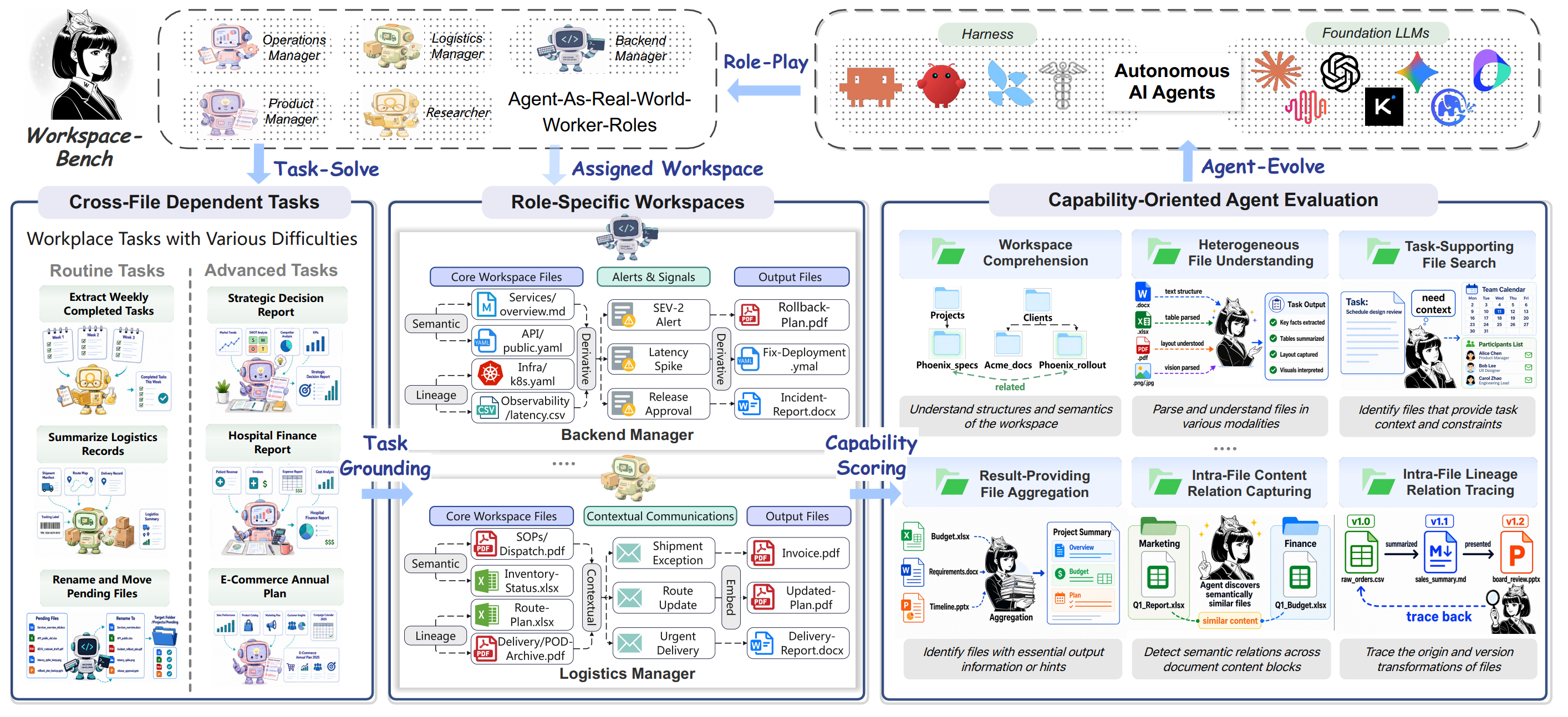
The figure above summarizes the overall Workspace-Bench framework that Lite inherits from the full benchmark: role-specific workspaces, cross-file dependent tasks, and capability-oriented rubric evaluation. Workspace-Bench-Lite keeps this same evaluation setting while offering a more lightweight split for faster experimentation.
In the Workspace-Bench paper, the Lite split is described as a 100-task subset that preserves the benchmark distribution while reducing evaluation costs by about 70%. This makes it a practical entry point for researchers and developers who want to evaluate workspace agents without running the full 388-task benchmark.
The Lite split remains grounded in the same benchmark philosophy as the full version:
- realistic workspace tasks rather than isolated QA
- heterogeneous files rather than single-format inputs
- dependency-aware task solving rather than direct prompt lookup
- rubric-based evaluation rather than only final-answer matching
LeaderBoard

The figure above shows a leaderboard snapshot of rubric pass rates on Workspace-Bench-Lite across different agent harnesses and backbone models. It highlights the same central takeaway as the full benchmark: current agents still show a clear gap from human-level performance, and both the foundation model and the harness design materially affect final results.
Distribution

The distribution figure provides a compact overview of the Lite split, including file types, task abilities, task difficulty, workspace allocation, rubric counts, required files per task, and dependency structure. Although lighter than the full benchmark, Workspace-Bench-Lite is designed to preserve the key distributional characteristics of Workspace-Bench.
Repository Contents
This repository provides the cleaned task metadata release for Workspace-Bench-Lite. It is paired with the workspace filesystem archives in Workspace-Bench-Workspaces, rather than storing the large raw workspace contents in this repository.
Current contents include:
task_lite_clean_en/: cleaned English Lite task metadata organized byabsolute_idtask_lite_clean_cn/: cleaned Chinese Lite task metadata organized byabsolute_idtask_lite_clean_en_metadata_table.csv: a flat English Lite metadata table for analysis and filteringtask_lite_clean_cn_metadata_table.csv: a flat Chinese Lite metadata table for analysis and filtering
At the time of writing, each language split contains 100 tasks, one folder per task ID. Task metadata files include a language field: "en" for English tasks and "cn" for Chinese tasks.
Quick Start
Please refer to the official GitHub repository for benchmark setup, evaluation instructions, and updates:
- GitHub repository: https://github.com/OpenDataBox/Workspace-Bench
More Lite-specific usage notes will be added in future updates.
Changelog
2026-07-02
- Added a
languagefield to taskmetadata.jsonfiles and metadata table CSV files. The value is"en"for English tasks and"cn"for Chinese tasks. - Tasks
95,328, and388: placed the required input files explicitly under their designated paths in the workspace filesystem, so agents can find the files from the workspace context. - Tasks
288,289, and258: replaced corrupted input files with readable workspace files. - Tasks
289,274,334, and108: refined selected rubrics to make the evaluation criteria more precise, self-consistent, and aligned with the expected output format.
Citation
If you use Workspace-Bench-Lite in your research, please cite the Workspace-Bench paper:
@misc{tang2026workspacebench10benchmarkingai,
  title={Workspace-Bench 1.0: Benchmarking AI Agents on Workspace Tasks with Large-Scale File Dependencies},
  author={Zirui Tang and Xuanhe Zhou and Yumou Liu and Linchun Li and Weizheng Wang and Hongzhang Huang and Jun Zhou and Jiachen Song and Shaoli Yu and Jinqi Wang and Zihang Zhou and Hongyi Zhou and Yuting Lv and Jinyang Li and Jiashuo Liu and Ruoyu Chen and Chunwei Liu and GuoLiang Li and Jihua Kang and Fan Wu},
  year={2026},
  eprint={2605.03596},
  archivePrefix={arXiv},
  primaryClass={cs.AI},
  url={https://arxiv.org/abs/2605.03596}
}