| --- |
| license: apache-2.0 |
| base_model: openbmb/VoxCPM2 |
| pipeline_tag: text-to-speech |
| language: |
| - zh |
| datasets: |
| - pymaster/CrawlSinger-OS |
| tags: |
| - singing-voice-synthesis |
| - score-conditioned |
| - music |
| - arxiv:2607.27768 |
| spaces: |
| - pymaster/VocalRender-demo |
| --- |
| |
| # VocalRender |
|
|
| **VocalRender: Score-Native Singing Voice Synthesis for Real-World Composition** |
|
|
| - [Paper](https://arxiv.org/abs/2607.27768) |
| - [Code and documentation](https://github.com/pymaster17/VocalRender) |
| - [Online inference demo](https://huggingface.co/spaces/pymaster/VocalRender-demo) |
| - [Open-source training dataset](https://huggingface.co/datasets/pymaster/CrawlSinger-OS) |
|
|
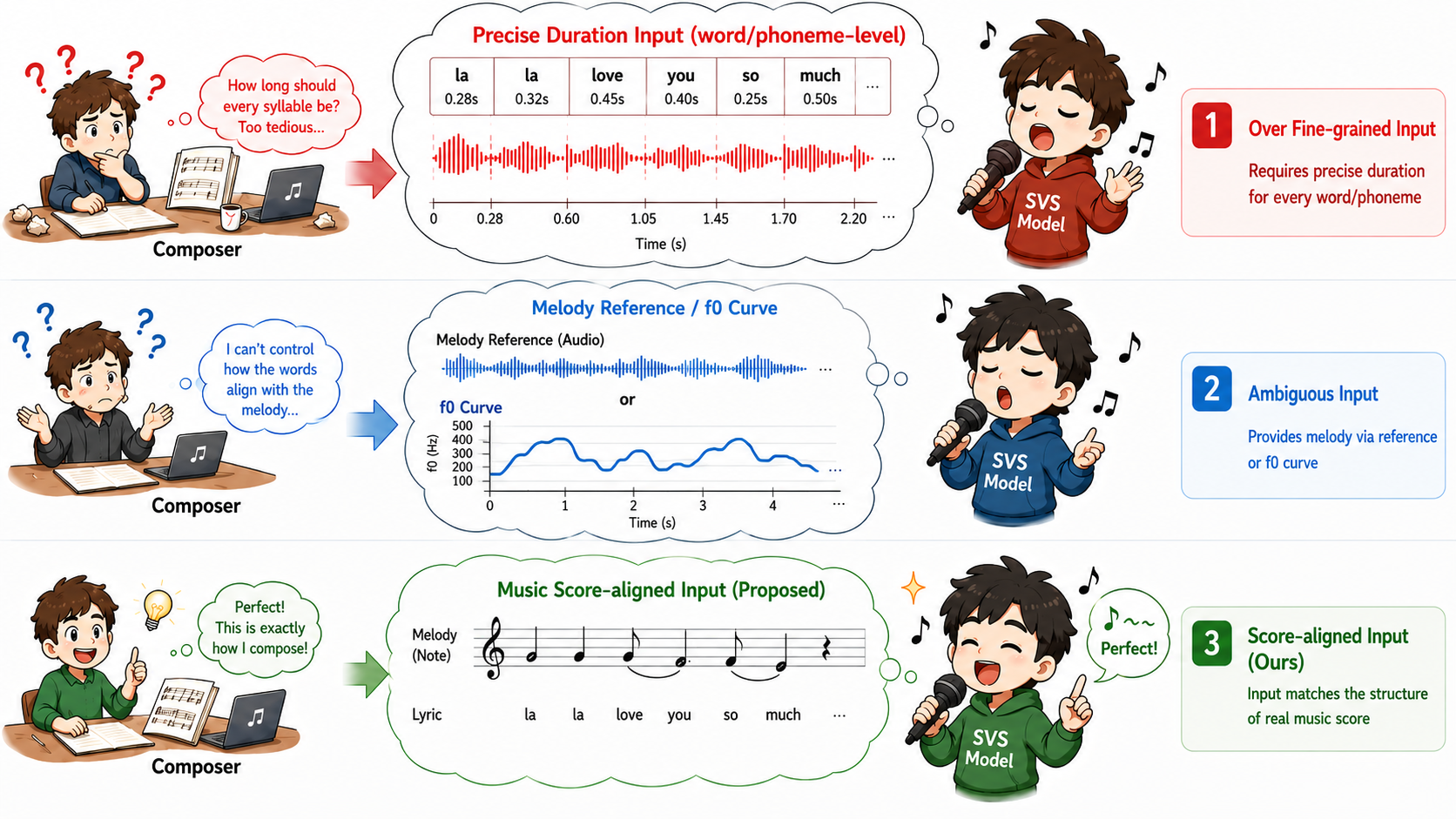
| VocalRender is a score-native singing voice synthesis (SVS) model designed for |
| real-world composition. It synthesizes 48 kHz singing directly from lyrics, |
| MIDI pitches, symbolic note values, and tempo through an original combination |
| of an interleaved lyric--note representation, continuous acoustic latents, and |
| autoregressive diffusion modeling. It does not require phoneme-level |
| durations, an explicit duration predictor, or a time-aligned acoustic |
| reference. |
|
|
|  |
|
|
| ## For musicians: try it without writing code |
|
|
| You do not need to understand machine learning or install the model to try |
| VocalRender. Open the **[online VocalRender demo](https://huggingface.co/spaces/pymaster/VocalRender-demo)** |
| and work with familiar score formats in your browser. |
|
|
| ### What VocalRender does |
|
|
| VocalRender sings a melody that you provide. You choose the lyrics, notes, |
| rhythm, tempo, and a short voice reference; the model renders them as a singing |
| voice. It is a score renderer rather than an automatic composer: it does not |
| write the melody or arrange an accompaniment for you. |
|
|
| ### What to prepare |
|
|
| - **A melody:** paste ABC notation, upload an ABC file, or upload MusicXML from |
| notation software such as MuseScore. You can also enter notes manually. |
| - **Chinese lyrics:** embedded ABC `w:` or MusicXML lyrics can be imported. If |
| the score has no note-aligned lyrics, type or paste them in the lyrics box. |
| - **A voice reference:** select one of the included voices, or upload 2–8 |
| seconds of clean, unaccompanied singing that you have permission to use. The |
| clip supplies the vocal color; it does not need to be the same song. |
|
|
| ### Score-to-song workflow |
|
|
| 1. Open **Import ABC notation or MusicXML**, provide your score, and press |
| **Parse score**. |
| 2. Check the suggested vocal part, lyric line, and measure range. The demo |
| preselects a short range that fits the model; you can change it. |
| 3. Press **Load selected range into editor**. Review the lyrics, pitches, |
| durations, and BPM, then press **Generate Singing**. |
|
|
| In the editor, MIDI pitch `60` means middle C (`C4`), and pitch `0` means a |
| rest. **+ Melisma note** lets one lyric syllable continue across multiple |
| notes. `SP` represents a rest or breath. |
|
|
| The released checkpoint currently works best with Mandarin Chinese and a |
| single vocal melody. Chord names in ABC, such as `"C"` or `"G7"`, are treated |
| as accompaniment labels and ignored, but actual simultaneous notes are not |
| supported. For piano or ensemble scores, select a monophonic vocal/melody part. |
| The demo reports unsupported passages instead of silently guessing which note |
| should be sung. |
|
|
| ## How it works |
|
|
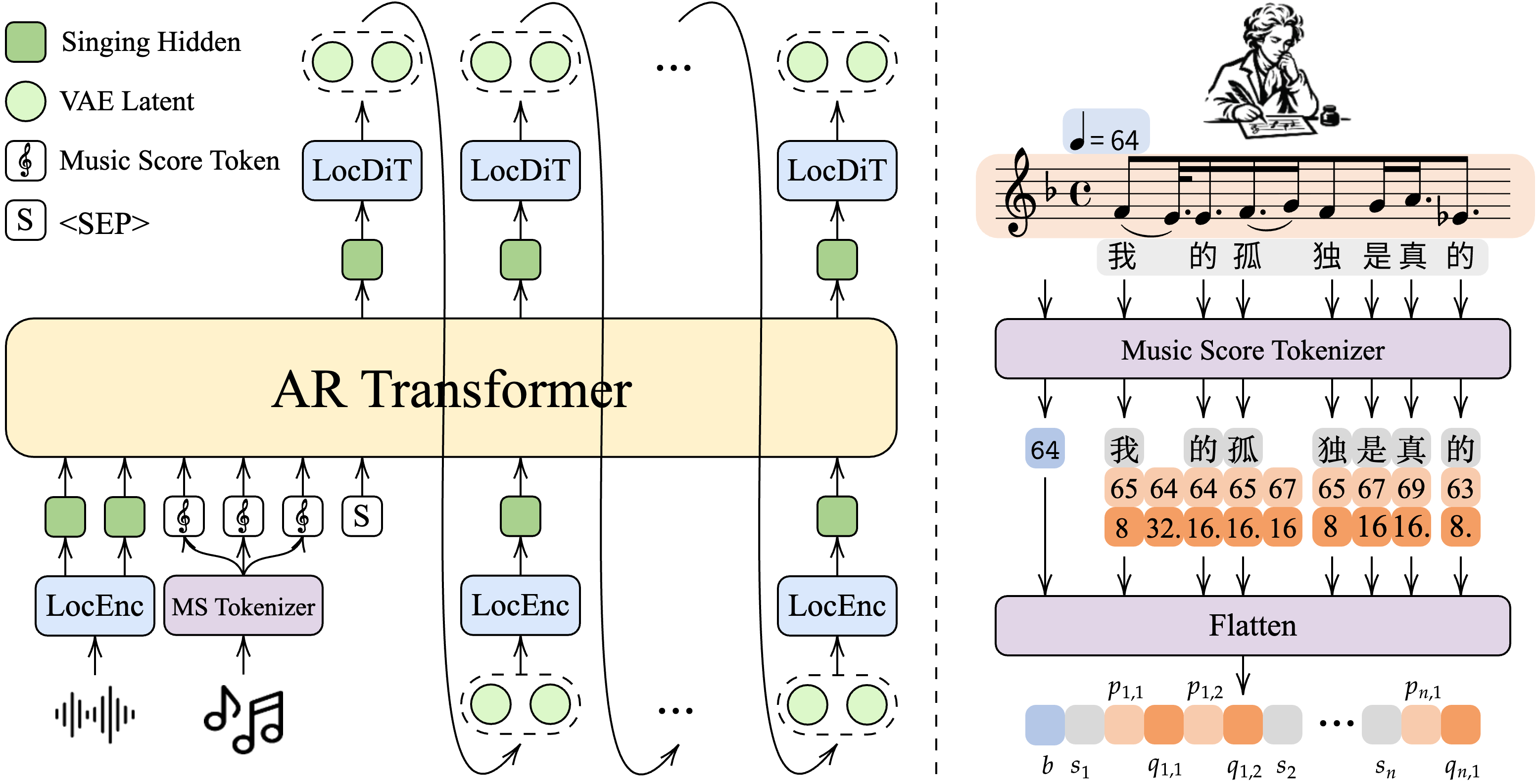
| VocalRender combines three components: |
|
|
| 1. A score-native interleaved representation serializes BPM followed by each |
| lyric syllable and its associated `(pitch, note-value)` pairs. This retains |
| lyric-to-note alignment and supports melisma. |
| 2. An Audio VAE represents singing as compact continuous acoustic latents. |
| 3. An autoregressive diffusion model generates the latent sequence patch by |
| patch and decides when to stop. The VAE decoder renders the result as a |
| waveform. |
|
|
|  |
|
|
| ## Checkpoints |
|
|
| This repository contains two variants with the **same architecture, parameter |
| count, and speech-pretrained base-model initialization**. Their only |
| difference is the training recipe (training corpus and schedule): |
|
|
| | Variant | Repository path | Training data and strategy | Paper results | |
| | --- | --- | --- | --- | |
| | **VocalRender** | `VocalRender/` | CrawlSinger-OS (>2,300 h); 40k-step synthetic pretraining followed by 20k-step real-data finetuning | Stronger subjective score following (MS-MOS 2.96) | |
| | **VocalRender-Pro** | `VocalRender-Pro/` | CrawlSinger (>5,600 h of in-house real singing); 160k training steps | Better intelligibility, speaker similarity, naturalness, and OOD robustness; MS-MOS 2.71 | |
|
|
| VocalRender-Pro reduces WER from 4.44 to 3.88 and improves speaker similarity |
| from 0.922 to 0.929 on Opencpop. On CrawlSinger-Eval, WER changes from 4.52 to |
| 4.45 and similarity from 0.919 to 0.926. The paper relates these improvements |
| to the larger amount of real singing and broader singer coverage. VocalRender's |
| higher score-following score may reflect more reliable score annotations in |
| its real-data finetuning subset. |
|
|
| Each directory contains the model weights, AudioVAE, model configuration, and |
| extended SVS tokenizer required by the inference code. Both checkpoints have |
| the same model size; each is approximately 9.5 GB to download. |
|
|
| ## Installation |
|
|
| ```bash |
| git clone --recurse-submodules https://github.com/pymaster17/VocalRender.git |
| cd VocalRender |
| uv sync |
| source .venv/bin/activate |
| ``` |
|
|
| ## Download |
|
|
| Download either checkpoint into the repository's `pretrained_models/` |
| directory: |
|
|
| ```bash |
| # VocalRender |
| hf download pymaster/VocalRender \ |
| --include "VocalRender/*" \ |
| --local-dir pretrained_models |
| |
| # Or VocalRender-Pro |
| hf download pymaster/VocalRender \ |
| --include "VocalRender-Pro/*" \ |
| --local-dir pretrained_models |
| ``` |
|
|
| ## Quick inference |
|
|
| The GitHub repository includes three ready-to-use prompt/score pairs selected |
| from OpenCpop. This command runs the first demo: |
|
|
| ```bash |
| python scripts/infer_vocalrender_svs_single.py \ |
| --ckpt_dir pretrained_models/VocalRender \ |
| --json_file examples/opencpop_demo.json \ |
| --item_name 2003000087 \ |
| --prompt_audio examples/prompt_audio/2003000081.wav \ |
| --output demo_2003000087.wav |
| ``` |
|
|
| Additional bundled pairs are `2017000646` with prompt `2017000644.wav`, and |
| `2044001652` with prompt `2044001666.wav`. The prompt clips are 4.19-6.17 |
| seconds long and do not overlap their paired target segment. Clone the |
| [GitHub repository](https://github.com/pymaster17/VocalRender) to obtain the |
| scripts and examples. The excerpts remain subject to the |
| [OpenCpop](https://wenet.org.cn/opencpop/) terms. |
|
|
| Use `pretrained_models/VocalRender-Pro` as `--ckpt_dir` to run the Pro model. |
| Full generation requires a CUDA-capable compute node. Prompt audio is required: |
| the released checkpoints were trained with prompt audio on every sample |
| (`prompt_audio_prob=1.0`), so prompt-free inference is unsupported and may |
| substantially degrade quality. Use a clean 2-8 second singing clip, which also |
| provides the target timbre. See the |
| [repository README](https://github.com/pymaster17/VocalRender#batch-inference) for |
| batch-inference options. |
|
|
| ## Input format |
|
|
| ```json |
| { |
| "item_name": "demo", |
| "word": ["我", "的", "孤", "独"], |
| "pitch": [65, 64, 64, 65, 67, 65], |
| "note": ["<NOTE_8>", "<NOTE_32>", "<NOTE_16>", "<NOTE_16>", "<NOTE_16>", "<NOTE_8>"], |
| "pitch2word": [0, 1, 2, 2, 2, 3], |
| "bpm": 64 |
| } |
| ``` |
|
|
| `pitch2word[i]` identifies the lyric index associated with note `i`, allowing |
| one lyric syllable to span multiple notes. `word_dur` and `pitch_dur` are |
| optional fields used only for visualization and evaluation; they are not model |
| inputs. |
|
|
| ## Limitations |
|
|
| - The released checkpoints primarily target Mandarin Chinese singing. |
| - Checkpoint loading and generation require substantial disk space, system |
| memory, and GPU memory. |
| - Output quality depends on the musical validity and lyric-to-note alignment of |
| the input score. |
|
|
| ## Model foundation |
|
|
| The released implementation initializes its ARDM backbone from the |
| speech-pretrained [VoxCPM2](https://huggingface.co/openbmb/VoxCPM2) weights. |
| The score-native representation, SVS formulation, data pipeline, and singing |
| training recipe are introduced by VocalRender. |
|
|
| ## Citation |
|
|
| ```bibtex |
| @article{chen2026vocalrender, |
| title = {VocalRender: Score-Native Singing Voice Synthesis for Real-World Composition}, |
| author = {Chen, Yukun and Wang, Tianrui and Mu, Zhaoxi and Yang, Xinyu and Chng, EngSiong}, |
| journal = {arXiv preprint arXiv:2607.27768}, |
| year = {2026}, |
| url = {https://arxiv.org/abs/2607.27768} |
| } |
| ``` |
|
|
| ## License |
|
|
| Apache License 2.0. See the repository's `LICENSE` file for details. |
|
|

