

RynnValue
Collection
RynnValue: Scaling Robotic Value Foundation Models with Temporal Distance • 3 items • Updated • 3
🏠 Homepage | 💻 GitHub | 🤗 HuggingFace | 🔮 ModelScope | 📄 ArXiv
A general-purpose value foundation model for robot manipulation — and the full toolchain to evaluate it and use it for reinforcement learning of VLA policies.
RynnValue is a RynnBrain-based vision-language model (implemented on the Qwen3-VL architecture) that watches a robot video together with a task instruction and predicts, for every frame, the temporal distance — the remaining time (in seconds) until the task is completed — alongside a natural-language analysis of the trajectory (video description, instruction–video match, task success). Because temporal-distance labels are derived directly from timestamps, RynnValue scales to 7,000+ hours of heterogeneous embodied data (~3M instruction-conditioned clips) without any preference or progress annotations. The predicted time-to-completion is a dense, task-grounded value signal that can be used directly as a progress estimator, a reward model for policy evaluation and ranking, or a critic for reinforcement learning of vision-language-action (VLA) policies.
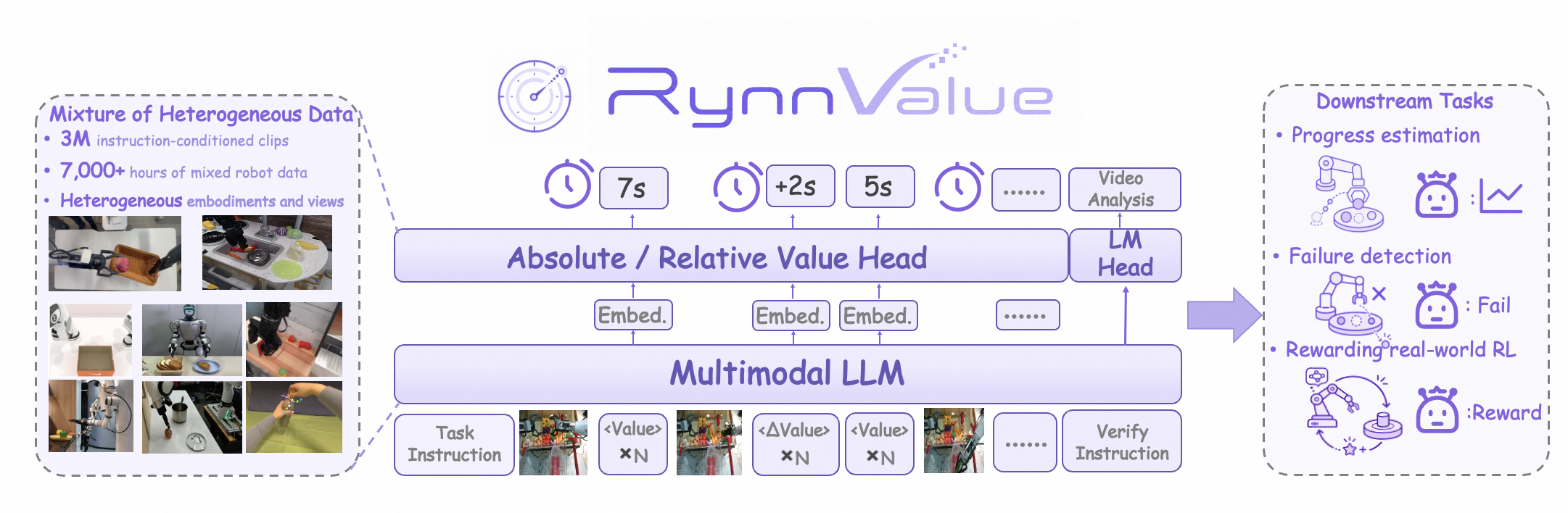
Overview. Given a language instruction and a sequence of sampled observations, RynnValue builds an interleaved multimodal sequence of repeated absolute-value (
<value>) and relative-value (<relative_value>) query groups, encoded by the RynnBrain backbone in a single forward pass. Two distributional heads predict the absolute temporal distance to task completion and the signed relative temporal displacement between observations, while the LM head produces video analysis and task verification. The resulting temporal values serve as a unified interface for progress estimation, failure detection, and reward specification in robotic RL.
This repository bundles the complete stack:
| Component | Directory | What it does |
|---|---|---|
| RynnValue model | rynn_value/ |
HuggingFace-compatible model definition (config / model / processor), value heads, value tokenizer, custom attention |
| Inference demo | rynn_infer/ |
Run RynnValue on any video + instruction, render an annotated video with the live remaining-time curve |
| Reward-model benchmark | robometer/ |
Fork of Robometer with a rynnvalue baseline adapter: reward alignment, policy ranking, and confusion-matrix evaluation, plus an HTTP reward server |
| VLA policy RL | pi-rl/ |
Fork of openpi (π₀ / π₀-FAST / π₀.₅) extended with offline IQL fine-tuning and online DSRL-style SAC latent steering, on LIBERO, RoboTwin, and real Franka robots |
| Tools | tools/ |
Convert training checkpoints to standalone HuggingFace trust_remote_code models |
| Example | example/ |
Demo video for the inference script |
[0,1] progress, RynnValue predicts the goal-conditioned cost-to-go in physical seconds. Labels come directly from timestamps (plus subtask segmentation and cutoff relabeling), so supervision scales to 7,000+ hours / ~3M clips across 10 heterogeneous data sources (AgiBot, EgoDex, Open X-Embodiment, RoboMIND, RoboTwin, …) without a single preference or progress annotation.pred_slot_isolated_eager) keeps each value-query group visible only to its own language–visual context, so predictions can't extrapolate from other value tokens. Ablations: removing shuffling drops τₐ from 0.675 → 0.189, removing isolation → 0.482, uniform sampling → 0.379.[0, 512] s) and relative ([−256, 256] s) temporal targets are discretized into 256 symlog-spaced bins with two-hot encodings, decoded back to continuous seconds at inference — stable regression over the long-tailed duration distribution of multi-embodiment data.Analysis block: a video description, a Match: Yes/No verdict (does the video match the instruction?), and a Success: Yes/No verdict. Instruction-mismatch augmentation (10% of training samples) teaches the model to detect instruction–video mismatches instead of always reporting smooth progress.Φ_t = −v_t), RynnValue raises real-world dual-arm Franka policy success from 52.5% → 72.5% online and 63.8% → 82.5% offline over the strongest reward-model baseline. ┌────────────────────────────────────────────────────────┐
Instruction ───►│ │
Metadata ─────►│ RynnBrain backbone (RynnValueLangModel) │──► Analysis text
Frames ───────►│ │ (description / Match / Success)
│ hidden states at repeated query-token positions │
└───────┬──────────────────────────────┬─────────────────┘
│ <value> group (×N) │ <relative_value> group (×N)
▼ ▼
absolute value head relative value head
(256 symlog bins, two-hot) (256 symlog bins, two-hot)
│ │
▼ ▼
remaining time per frame signed Δt between adjacent frames
The architecture follows the paper (§2, Model Architecture):
symexp.Video Description → Match → Success through the original (frozen) LM head.The prompt (built by rynn_value/conversations.py) interleaves an optional embodiment/camera meta block, the task instruction, the two value questions, per-frame images followed by their <relative_value> / <value> token slots, and finally the analysis request. The processor (rynn_value/processing_rynn_value_lang.py) exposes a single-call inference API, process_episode(instruction, images, robot_description, camera_description).
Key implementation files:
| File | Contents |
|---|---|
rynn_value/configuration_rynn_value_lang.py |
RynnValueLangConfig (extends Qwen3VLConfig), ValueTokenizerConfig (bins, support transform, encoding), ValueHeadConfig (linear / BRO) |
rynn_value/modeling_rynn_value_lang.py |
RynnValueLangModel — value-head ensemble, relative head, cross-entropy losses over encoded targets, mismatch fusion mask, RynnValueLangOutputWithPast |
rynn_value/value_tokenizer.py |
Scalar ↔ bin-distribution codec (two-hot encoding) |
rynn_value/value_heads.py |
LinearValueHead, BroValueHead / BroNet |
rynn_value/attention_impl.py |
pred_slot_isolated_eager attention registration |
rynn_value/processing_rynn_value_lang.py |
Processor: special tokens, training target construction, process_episode inference API |
The package self-registers with HuggingFace Auto classes (AutoConfig / AutoModel / AutoProcessor under model type rynn_value_lang), so exported checkpoints load with trust_remote_code=True and nothing else.
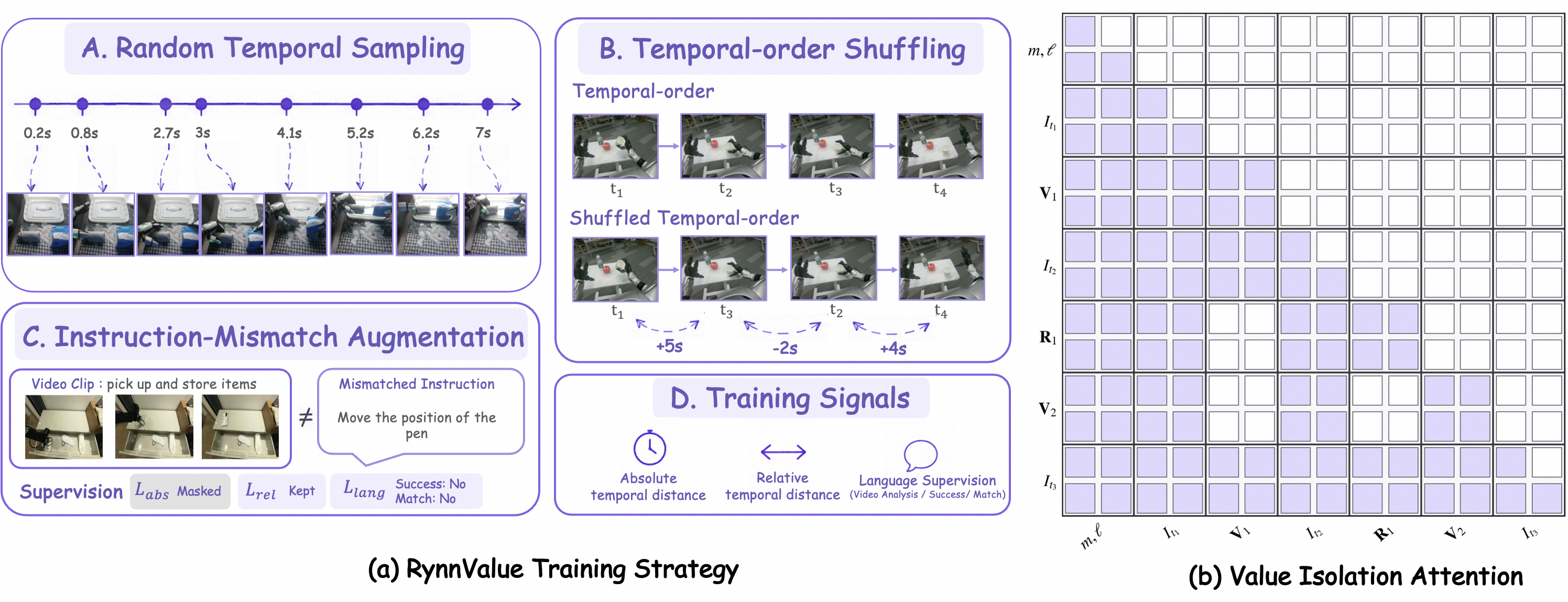
(a) Training strategy. Random temporal sampling and temporal-order shuffling suppress shortcuts tied to sampling intervals and sequence position, while instruction-mismatch augmentation strengthens language–visual grounding. (b) Value-isolation attention. Within each value-query group, repeated queries attend to one another and to the language–visual context, while remaining isolated from other value-query groups.
Data. RynnValue is trained on a heterogeneous mixture of real-world, simulated, and egocentric trajectories — 1.67M original episodes expanded into 3.09M instruction-conditioned segments (7,000+ hours, 223K unique instructions) via subtask segmentation and cutoff relabeling:
| Data Source | # Original Episodes | # Segmentations |
|---|---|---|
| Open X-Embodiment | 693,037 | 693,037 |
| EgoDex | 338,234 | 338,234 |
| InternData-A1 | 320,905 | 320,905 |
| AgiBot | 167,535 | 1,166,042 |
| RoboCOIN | 67,420 | 410,877 |
| RoboMIND | 32,138 | 32,138 |
| RoboTwin | 27,414 | 27,414 |
| Galaxea Open-World | 16,979 | 95,671 |
| RDT | 6,109 | 6,109 |
| Soft-FOLD | 1,542 | 1,542 |
| Total | 1,671,313 | 3,091,969 |
Temporal-distance labels are generated directly from timestamps: observations before the completion cutoff are labeled with their remaining time; observations at or after the cutoff receive zero. Qwen3-VL-27B captions supervise the Video Description output.
Objectives. Three jointly optimized cross-entropy losses: (1) absolute temporal-distance loss over two-hot bin targets (masked for instruction-mismatched samples); (2) relative temporal-distance loss (instruction-independent, kept for mismatched samples); (3) causal LM loss over the Video Description / Match / Success tokens (weight λ = 2, LM output projection frozen).
Shortcut suppression. For each clip, K = 8 observations are sampled at irregular timestamps (random temporal sampling); half of the sequences are unsorted, the rest follow a forward-biased temporal walk with occasional rewinds (temporal-order shuffling) — so relative targets can be negative. Together with value-isolation attention, this forces every prediction to be grounded in the corresponding observation and task semantics. For 10% of samples the instruction is swapped with one from a different trajectory (instruction-mismatch augmentation) and supervised toward Match: No / Success: No.
Reward interface. At inference, frames are fed chronologically and decoded into remaining time v_t. The potential Φ_t = −v_t yields dense rewards via potential-based shaping (r_t = γ^H Φ_{t+H} − Φ_t), preserving the physical temporal scale rather than normalizing to a task-specific [0,1] interval.
Policy ranking (RBM-EVAL-OOD). Trained without preference labels, RynnValue-8B reaches an average Kendall's τₐ of 0.675, surpassing the fully preference-supervised state of the art (0.655) and more than doubling a progress-only counterpart (0.292).
Instruction–trajectory alignment. Scoring every instruction against every trajectory, RynnValue produces the clearest diagonal structure with the highest normalized diagonal margin (0.79 vs. 0.67 for the strongest baseline):

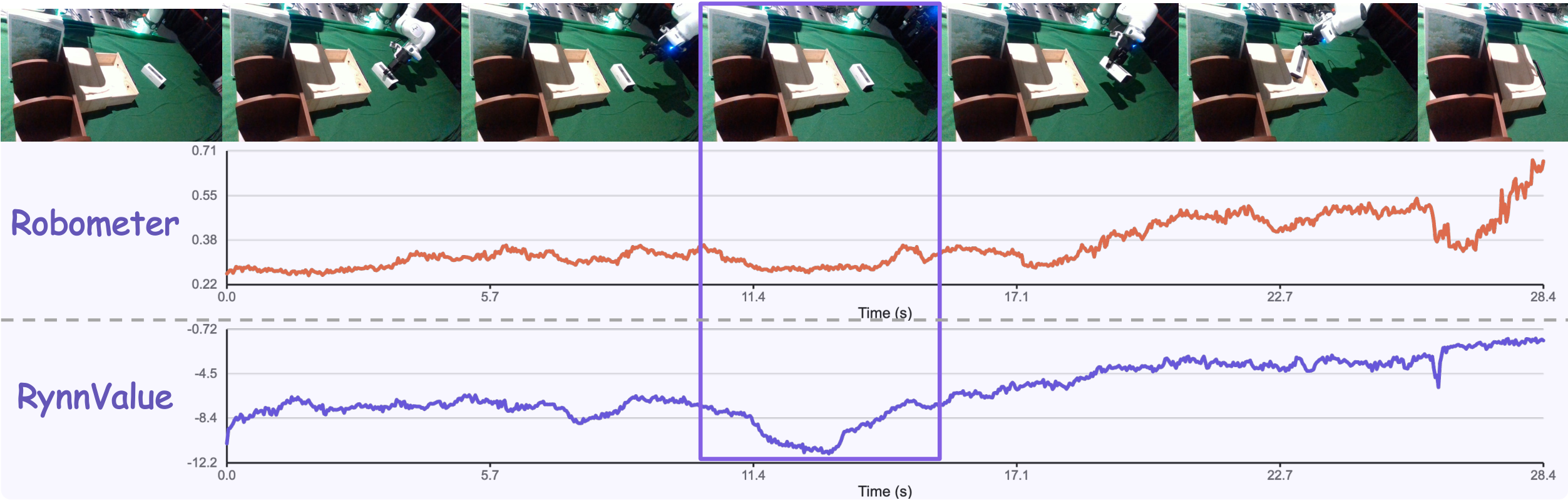
Value-curve quality. On real-world trajectories, RynnValue reacts sharply to task regressions and recoveries where normalized-progress baselines stay flat:
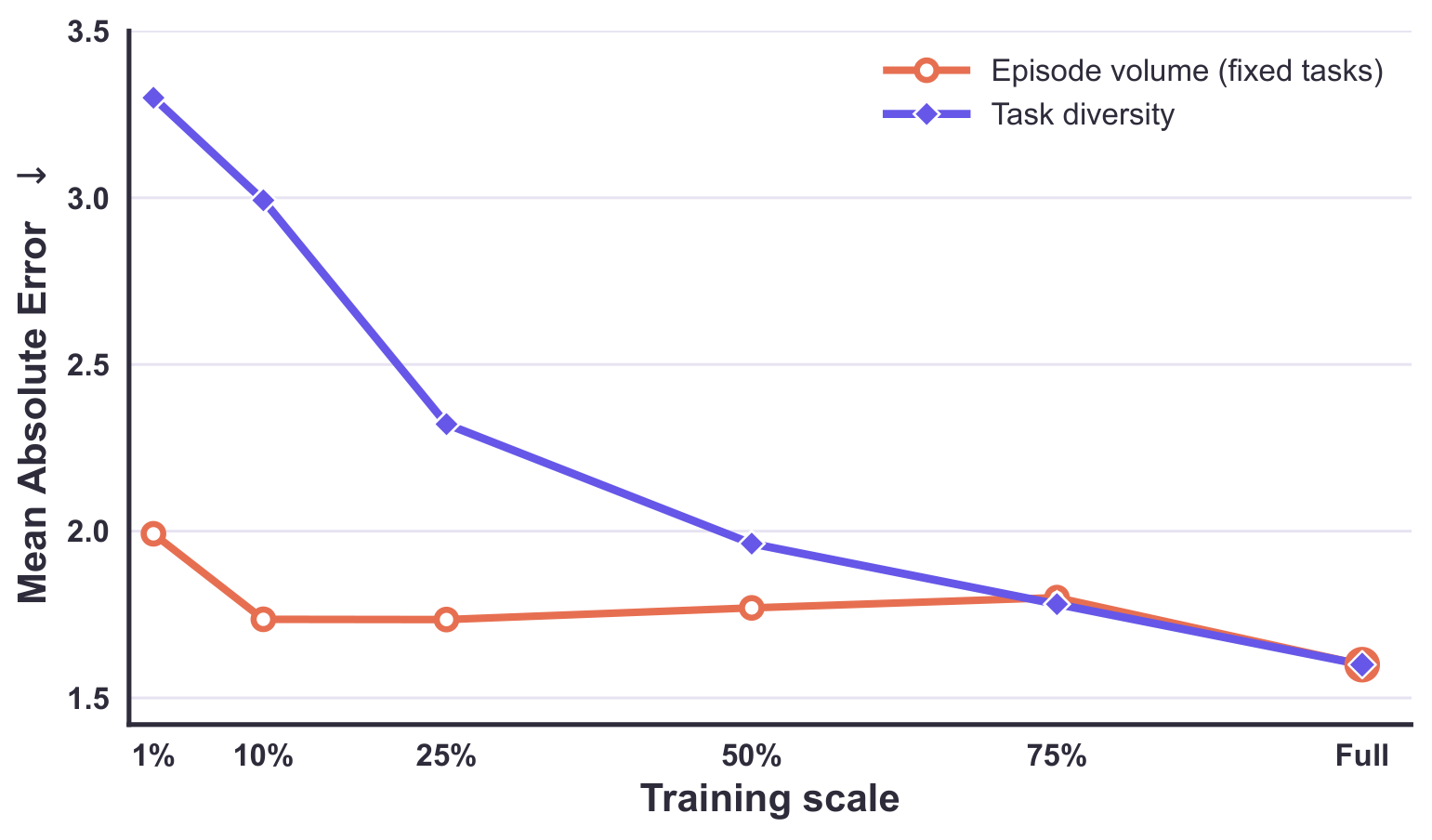
Scaling behavior. Task diversity — not episode volume — drives generalization: scaling episode count within fixed tasks saturates almost immediately, while adding tasks monotonically reduces temporal-distance error on unseen tasks:
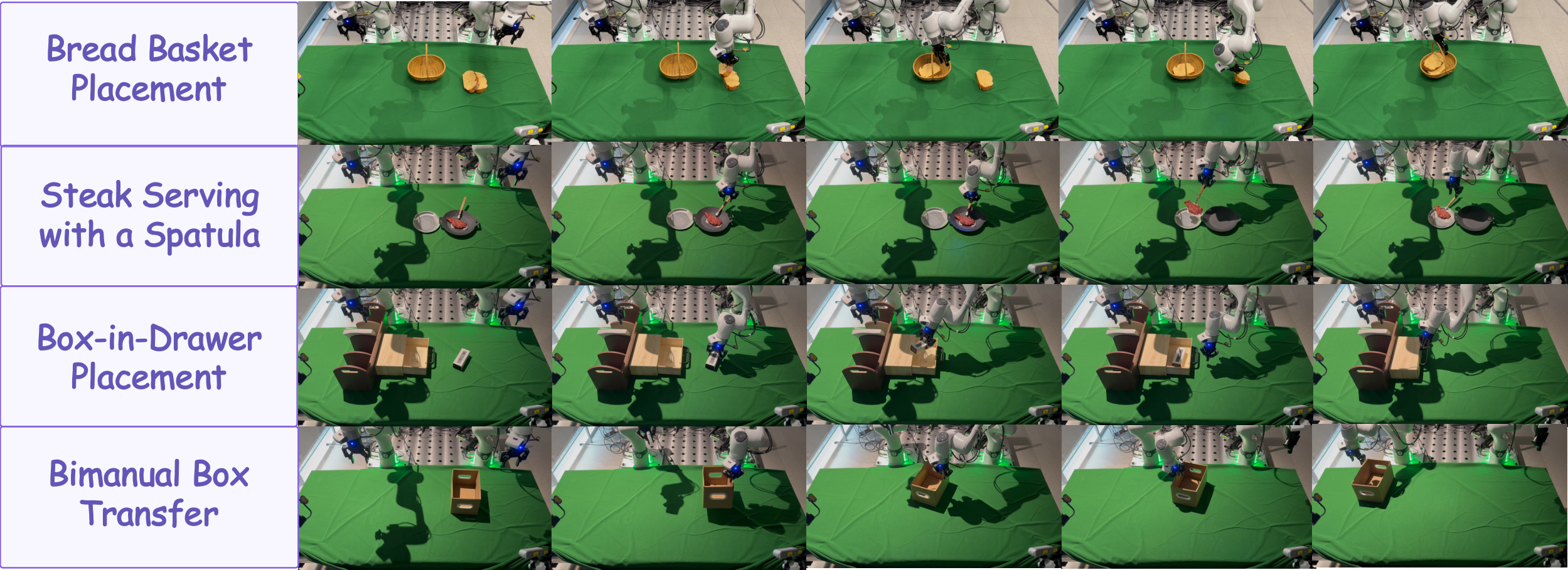
Real-world policy learning. Used as a zero-shot reward annotator (none of the tasks, objects, or scenes appear in training) on a dual-arm Franka across four manipulation tasks, RynnValue-shaped rewards raise average success from 52.5% → 72.5% (online RL) and 63.8% → 82.5% (offline RL) over the strongest reward-model baseline:
RynnValue001/
├── rynn_value/                 # RynnValue model package (HF trust_remote_code style)
├── rynn_infer/
│   ├── inference.py            # CLI: video + instruction → value curve + analysis
│   ├── plot_utils.py           # save_video_with_trend(): renders annotated output video
│   └── outputs/                # sample inference outputs
├── robometer/                  # Robometer benchmark fork (reward-model training + eval)
│   ├── robometer/
│   │   ├── configs/            # Hydra configs (reward_model/rynnvalue.yaml, distributed/fsdp.yaml, …)
│   │   ├── models/             # RBM (progress/preference/success heads), ReWiND transformer
│   │   ├── evals/              # run_baseline_eval.py, eval/baseline servers, baselines/rynnvalue.py
│   │   ├── data/ trainers/     # dataset + training code
│   ├── rynnvalue_eval/         # RynnValue-specific eval launchers (policy ranking, confusion matrix, server)
│   ├── eval_commands/          # eval commands for the other baselines
│   ├── dataset_upload/         # converters to the RBM HF dataset format (LIBERO, AgiBotWorld, custom)
│   └── train.py                # reward-model training entry (accelerate + FSDP, LoRA)
├── pi-rl/                      # openpi fork + RL
│   ├── src/openpi/             # π₀ / π₀.₅ models (JAX + PyTorch), training, RL data loading
│   ├── scripts/                # train.py, train_iql.py, serve_policy.py, launch scripts
│   ├── configs/                # RL configs (SAC, TD, DAgger, EXPO)
│   ├── examples/               # libero, droid, aloha, dsrl_sim, dsrl_franka, franka (real robot), …
│   ├── packages/openpi-client/ # websocket policy client
│   └── third_party/jaxrl2/     # vendored jaxrl2 (pi_iql, pixel_iql, pixel_sac)
├── tools/
│   └── convert_rynn_value_lang_to_hf.py   # training ckpt → standalone HF model
└── example/
    └── Put_the_box_in_the_drawer_and_close_it.mp4
Each component manages its own environment. Python 3.10 is required throughout.
rynn_value + rynn_infer)
Managed with uv via the top-level pyproject.toml:
uv sync # creates .venv with torch / transformers / imageio / …
A recent transformers with Qwen3-VL support is required (pinned in pyproject.toml). A single GPU with ≥ 24 GB memory comfortably runs the 8B model in bf16.
cd robometer
uv sync                     # Python 3.10, uv-managed (see pyproject.toml / uv.lock)
See robometer/README.md and robometer/FINETUNE_ROBOMETER.md for dataset download, reward-model fine-tuning (LoRA + FSDP), and the full baseline matrix.
cd pi-rl
GIT_LFS_SKIP_SMUDGE=1 uv sync           # JAX 0.5.3 (cuda12), flax, torch 2.7.1, lerobot, …
GPU requirements follow upstream openpi: > 8 GB for inference, > 22.5 GB for LoRA fine-tuning, > 70 GB (A100/H100) for full fine-tuning. See pi-rl/README.md.
Run RynnValue on the bundled example video:
cd rynn_infer
uv run python inference.py \
    --model_path /path/to/RynnValue-8B \
    --video_path ../example/Put_the_box_in_the_drawer_and_close_it.mp4 \
    --instruction "Put the box in the drawer and close it" \
    --num_frames 64 \
    --output_path ./outputs
Useful flags:
| Flag | Default | Meaning |
|---|---|---|
--num_frames |
64 | Frames uniformly sampled from the video (0 = all frames) |
--robot_description / --camera_description |
None | Embodiment/camera meta block (required for models trained with use_meta=True) |
--max_new_tokens |
128 | Token budget for the Analysis block |
--fps |
30 | FPS of the rendered trend video |
The script produces, in a timestamped output directory:
output_with_trend.mp4 — the input video with a synchronized Remaining Time (s) curve;Match: Yes/No, Success: Yes/No) and per-frame values.import torch
from transformers import AutoConfig, AutoModel, AutoProcessor
model_path = "/path/to/RynnValue-8B"
config = AutoConfig.from_pretrained(model_path, trust_remote_code=True)
config._attn_implementation = "pred_slot_isolated_eager"
model = AutoModel.from_pretrained(
model_path, config=config, torch_dtype=torch.bfloat16,
trust_remote_code=True, device_map="cuda",
).eval()
processor = AutoProcessor.from_pretrained(model_path, trust_remote_code=True)
# `images`: list of PIL.Image frames sampled from the trajectory video
inputs = processor.process_episode(
instruction="Put the box in the drawer and close it",
images=images,
).to(model.device)
with torch.no_grad():
out = model(**inputs)
remaining_time = out.value.pred_value.float().mean(dim=-1) # (num_frames,) seconds, head-ensemble mean
delta_time = out.relative.pred_value # per-step time deltas
entropy = out.value.entropy # per-frame uncertainty
The robometer/ fork adds RynnValue as a first-class baseline (robometer/robometer/evals/baselines/rynnvalue.py, Hydra config reward_model=rynnvalue). Ready-made launchers live in robometer/rynnvalue_eval/.
Policy ranking (does the value model rank better policies higher?):
cd robometer
ROBOMETER_PROCESSED_DATASETS_PATH=/path/to/processed/Robometer \
python robometer/evals/run_baseline_eval.py \
    'reward_model=rynnvalue' \
    'model_path=/path/to/RynnValue-8B' \
    'custom_eval.eval_types=[policy_ranking]' \
    'custom_eval.policy_ranking=[rbm-1m-ood]' \
    'max_frames=8' \
    'model_config.conversation_type=Progress'
Confusion matrix (cross-task instruction/video matching). Two scoring modes are supported via model_config.confusion_score_mode:
match_binary — score 1.0 iff the Analysis verdict is Match: Yes;normalized_value — the value head normalized to [0, 1] (1 − t/t_max) on matches, 0 otherwise.python robometer/evals/run_baseline_eval.py \
'reward_model=rynnvalue' \
'model_path=/path/to/RynnValue-8B' \
'custom_eval.eval_types=[confusion_matrix]' \
'custom_eval.confusion_matrix=[[...dataset ids...]]' \
'max_frames=8' \
'model_config.confusion_score_mode=match_binary'
See robometer/rynnvalue_eval/*.sh for complete examples and robometer/eval_commands/ for the other baselines. Dataset converters for LIBERO, AgiBotWorld, and custom datasets (DROID / Bridge style) live in robometer/dataset_upload/.
Serve RynnValue as an HTTP reward model (used by policy evaluation and online RL clients):
cd robometer
bash rynnvalue_eval/start_server.sh \
    --model-path /path/to/RynnValue-8B \
    --port 8001 --gpu 0 --num-frames 8 --batch-size 16
The server (robometer/robometer/evals/baseline_eval_server.py) accepts frame sequences + instructions and returns per-frame values / rewards. --checkpoint-path alternatively loads a raw training checkpoint (model.pt with a sibling huggingface/ snapshot). --mode absolute selects the remaining-time head; --debug attaches debugpy on :5678.
pi-rl/ is a fork of openpi that turns value/reward signals into better VLA policies. On top of upstream π₀ / π₀-FAST / π₀.₅ SFT (JAX and PyTorch), it adds:
scripts/train_iql.py): each step (1) updates a jaxrl2 PixelIQL critic/value, (2) computes the IQL advantage, (3) updates the π₀.₅ flow-matching policy with advantage-weighted BC (exp(A_scaling · adv)). RL-aware plumbing lives in src/openpi/training/{rl_data_loader,iql_checkpoints,episode_filter}.py. Registered configs include pi05_robotwin_iql, pi05_franka_single_iql, pi05_franka_dual_iql, and variants.PixelSAC agent steers the frozen π₀.₅ policy's latent noise online — in simulation (examples/dsrl_sim/, LIBERO OffScreenRenderEnv) and on a real Franka over WebSocket (examples/dsrl_franka/).examples/franka/: serving, fine-tuning, async online LoRA training) with LeRobot-format data converters (scripts/convert_franka_data_to_lerobot.py).Representative commands:
cd pi-rl

# supervised fine-tuning on RoboTwin
FSDP_DEVICES=2 bash scripts/train_pi05_robotwin.sh adjust_bottle-demo_clean_collect_200-50

# offline IQL on RoboTwin
bash scripts/train_iql_robotwin.sh
examples/dsrl_franka/ runs online SAC latent steering on a real (single- or dual-arm) Franka, optionally shaped by a RynnValue reward server. The launcher template is examples/dsrl_franka/scripts/run_train_franka.sh; the flow is:
1. (Optional) Start the RynnValue reward server for reward shaping (see Reward Server):
cd robometer && bash rynnvalue_eval/start_server.sh --model-path /path/to/RynnValue-8B --port 8000
2. Start the robot environment server (WebSocket) on the machine controlling the Franka, or skip this and use --fake_env for a quick dry run without hardware.
3. Launch online training. Point it at an IQL-initialized checkpoint (FRANKA_SFT_CKPT_BASE) and the env/reward servers:
cd pi-rl
export FRANKA_SFT_CKPT_BASE=/path/to/iql_checkpoint/10000   # offline-IQL warm start
export XLA_PYTHON_CLIENT_PREALLOCATE=false

python examples/dsrl_franka/launch_train_franka.py \
    --arm_mode dual \
    --policy_config pi05_franka_dual_iql_optimized_v2 \
    --update_type episode --utd_ratio 100 --publish_hz 10.0 \
    --client_host localhost --client_port 8101 \
    --pi0_action_horizon 16 \
    --franka_norm_stats_asset_id pick_up_the_box \
    --max_episodes 500 --franka_max_timesteps 600 \
    --start_online_updates 200 \
    --noise_episodes 2 --noise_std 0.1 \
    --score_server "http://localhost:8000" \
    --shaping_weight 1.0 --shaping_gamma 0.999 \
    --task_description "Move the box from the right side to the left side." \
    --checkpoint_interval 200 --checkpoint_dir ./experiments/dual_reward_shaping \
    --wandb_project dsrl_franka --seed 42
Key knobs:
| Flag | Meaning |
|---|---|
--arm_mode single/dual (+ --side left/right) |
Single- or dual-arm Franka |
--fake_env |
Local fake environment — verify the training loop without a robot |
--client_host / --client_port |
WebSocket address of the robot env server |
--score_server |
RynnValue/Robometer reward server URL; enables potential-based reward shaping (--shaping_weight, --shaping_gamma) |
--update_type episode / --utd_ratio |
Update after each episode with the given update-to-data ratio |
--noise_episodes / --noise_std |
Initial exploration episodes with Gaussian latent noise |
--start_online_updates |
Warm-up steps collected before SAC updates begin |
The same recipe runs in simulation via examples/dsrl_sim/launch_train_sim.py (LIBERO OffScreenRenderEnv).
See pi-rl/README.md for upstream documentation (checkpoints under gs://openpi-assets/checkpoints/: pi05_base, pi05_libero, pi05_droid, …), norm-stat computation, and policy serving.
Export a raw training checkpoint to a standalone HuggingFace model directory (embeds the modeling code for trust_remote_code loading):
uv run python tools/convert_rynn_value_lang_to_hf.py \
    --model_ckpt_path /path/to/checkpoint_model_XXXXXX \
    --output_path /path/to/RynnValue-8B-hf \
    --dtype bf16
--model_ckpt_path expects a directory containing model.pt with the matching huggingface/ processor/config snapshot next to it.
| Model | Backbone | Description |
|---|---|---|
RynnValue-4B |
RynnBrain 4B | Remaining-time value model with absolute + relative distributional heads and Analysis generation |
RynnValue-8B |
RynnBrain 8B | Remaining-time value model with absolute + relative distributional heads and Analysis generation |
Checkpoint release is in progress; update the paths above once the weights are published.
This repository builds on outstanding open-source work:
pi-rl/).robometer/).pi-rl/third_party/jaxrl2/).rynn_value/, rynn_infer/, tools/) are distributed under the Apache License 2.0 (see LICENSE).pi-rl/ is distributed under the Apache License 2.0 (see pi-rl/LICENSE) with additional Gemma terms in pi-rl/LICENSE_GEMMA.txt.robometer/ follows the upstream Robometer project under the MIT License (see robometer/LICENSE). It additionally vendors FSDP utilities derived from ByteDance's verl project (Apache-2.0; original copyright headers retained in robometer/robometer/utils/fsdp/).If you find RynnValue useful, please cite:
@article{rynnvalue2026,
  title  = {RynnValue: Scaling Robotic Value Foundation Models with Temporal Distance},
  author = {Dongchi Huang and Hongyin Zhang and Bohan Hou and Siteng Huang and Zhian Su and Hang Guo and Tong Lu and Zhaofeng Xu and Jiahao Tang and Jianfei Yang and Donglin Wang and Peixi Peng and Mingxiu Chen and Deli Zhao and Xin Li},
  journal= {arXiv preprint arXiv:2608.09853},
  year   = {2026},
}
Base model
Alibaba-DAMO-Academy/RynnBrain-4B